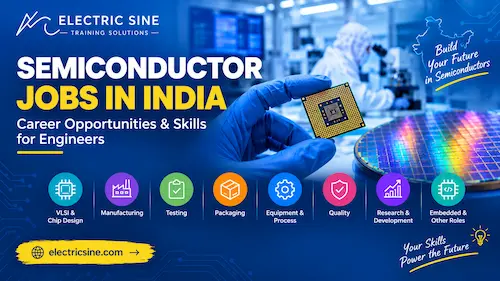
The semiconductor industry is becoming an important career area for engineering students, fresh graduates and experienced professionals in India. With the growth of semiconductor design, electronics manufacturing, chip fabrication, testing and packaging, the demand for specialized technical skills is expected to remain an important part of India's electronics ecosystem.
For students from Electrical Engineering, Electronics and Communication Engineering (ECE), Electronics Engineering, Instrumentation, Computer Science and related disciplines, semiconductor technology can offer multiple career paths.
India Semiconductor Mission (ISM) is working toward building a semiconductor and display ecosystem and positioning India as a global hub for electronics manufacturing and design.
What Is the Semiconductor Industry?
Semiconductors are materials and technologies used to manufacture electronic components such as integrated circuits (ICs), microprocessors, memory devices, sensors and other electronic chips.
These technologies are essential for smartphones, computers, automobiles, communication systems, artificial intelligence, healthcare equipment, defence systems and industrial electronics.
The semiconductor industry includes several stages, from chip design to manufacturing, testing and packaging.
Major areas include:
- Semiconductor chip design
- VLSI design
- Analog and digital IC design
- Verification and validation
- Semiconductor fabrication
- Wafer processing
- Assembly, Testing, Marking and Packaging (ATMP)
- Outsourced Semiconductor Assembly and Test (OSAT)
- Semiconductor testing
- Equipment maintenance
- Process engineering
- Quality control
- Semiconductor research and development
Why Are Semiconductor Jobs Growing in India?
India is developing its semiconductor ecosystem through government initiatives, manufacturing projects, design support and talent-development programmes.
According to MeitY's February 2026 update, approvals included one semiconductor fab, eight ATMP/OSAT facilities, one compound semiconductor fab and 24 semiconductor design companies under the Design Linked Incentive scheme.
This development creates opportunities not only in chip design but also in:
Manufacturing → Testing → Packaging → Equipment → Quality → Research → Engineering Services
Therefore, semiconductor careers are not limited to VLSI designers.
Top Semiconductor Jobs in India
1. VLSI Design Engineer
VLSI engineers work on designing integrated circuits containing thousands or millions of electronic components.
Typical areas include:
- Digital VLSI
- Analog VLSI
- RTL design
- ASIC design
- FPGA design
- Physical design
Useful skills
- Digital electronics
- CMOS fundamentals
- Verilog/SystemVerilog
- Computer architecture
- RTL design
- Linux
- Basic scripting
2. Verification Engineer
Verification engineers test whether a chip design behaves according to its specifications.
Important skills include:
- SystemVerilog
- UVM
- Digital electronics
- Verification methodologies
- Simulation tools
- Debugging
Verification is an important part of semiconductor product development because chip designs need extensive testing before manufacturing.
3. Physical Design Engineer
Physical design involves converting a logical chip design into a physical layout suitable for manufacturing.
Students interested in this area should learn:
- CMOS basics
- Digital electronics
- VLSI concepts
- Timing analysis
- Physical design flow
- Static Timing Analysis
- EDA tools
4. Analog Design Engineer
Analog engineers work with circuits that process continuously varying electrical signals.
Important topics include:
- Analog electronics
- MOSFET
- BJT
- Operational amplifiers
- Current mirrors
- Differential amplifiers
- ADC/DAC
- Semiconductor device fundamentals
Students who enjoy Analog Electronics and Circuit Theory may explore this career path.
5. Semiconductor Process Engineer
Process engineers are involved in semiconductor manufacturing processes.
Their work can involve:
- Wafer processing
- Process control
- Equipment monitoring
- Yield improvement
- Manufacturing processes
- Cleanroom processes
- Quality control
This area is particularly relevant as India develops semiconductor manufacturing and packaging capabilities.
6. Semiconductor Test Engineer
Testing is another important semiconductor career.
A test engineer may work on:
- IC testing
- Functional testing
- Automated Test Equipment (ATE)
- Failure analysis
- Test development
- Product validation
Knowledge of electronics, testing techniques and programming can be useful.
7. Semiconductor Equipment Engineer
Semiconductor manufacturing requires sophisticated equipment.
Equipment engineers may work on:
- Equipment maintenance
- Troubleshooting
- Automation
- Sensors
- Control systems
- Electrical systems
- Preventive maintenance
This can be particularly relevant for Electrical and Electronics Engineers.
8. Packaging Engineer
After semiconductor fabrication, chips need to be packaged and tested.
Packaging engineers may work with:
- Semiconductor packaging
- Assembly
- Testing
- Thermal management
- Packaging materials
- Reliability testing
The growth of ATMP/OSAT facilities makes semiconductor packaging another area for engineering careers.
9. Semiconductor Quality Engineer
Quality engineers focus on maintaining product and manufacturing quality.
Typical areas include:
- Quality control
- Failure analysis
- Process monitoring
- Reliability
- Root-cause analysis
- Statistical process control
10. Embedded & Semiconductor Engineering
Semiconductor careers can also overlap with embedded systems.
Skills such as:
- C/C++
- Microcontrollers
- Embedded systems
- Digital electronics
- ARM architecture
- RTOS
- Communication protocols
can be useful for roles connected with semiconductor products and embedded applications.
Which Engineering Branch Is Best for Semiconductor Jobs?
There is no single engineering branch that is limited to semiconductor careers.
Students from several disciplines can enter different parts of the semiconductor ecosystem.
| Engineering Branch | Possible Semiconductor Areas |
|---|---|
| ECE | VLSI, IC Design, Verification, Embedded |
| Electrical Engineering | Semiconductor Equipment, Power Electronics, Testing, Manufacturing |
| Electronics Engineering | VLSI, Analog/Digital Design, Testing |
| Instrumentation | Process Control, Sensors, Manufacturing |
| Computer Science | Semiconductor Software, Verification, Automation |
| Mechanical Engineering | Manufacturing Equipment, Packaging |
| Chemical Engineering | Semiconductor Manufacturing Processes |
The right career path depends on the student's technical interests and the skills they develop.
Skills Required for Semiconductor Jobs
A degree alone may not be sufficient for specialized semiconductor roles. Building practical technical skills can help students prepare for industry-oriented positions.
Core Electronics Skills
Start with:
- Basic Electronics
- Digital Electronics
- Analog Electronics
- Semiconductor Devices
- Circuit Theory
- Signals and Systems
VLSI Skills
For VLSI-oriented careers:
- CMOS
- Verilog
- SystemVerilog
- RTL Design
- FPGA
- ASIC
- VLSI Design Flow
- Verification
Programming Skills
Programming can also be valuable.
Consider learning:
- C
- C++
- Python
- Linux
- Shell scripting
Additional Skills
Depending on the role:
- MATLAB
- EDA tools
- Embedded systems
- PCB design
- Microcontrollers
- Data analysis
- Semiconductor testing
How Can Freshers Get a Semiconductor Job?
If you are an engineering student or fresher, follow a structured approach.
Step 1: Strengthen Electronics Fundamentals
Start with:
Semiconductor Devices → Analog Electronics → Digital Electronics → Microprocessors → VLSI
Step 2: Select a Career Track
Choose one primary area:
VLSI Design | Verification | Physical Design | Analog Design | Testing | Manufacturing | Packaging | Equipment
Step 3: Learn Industry-Relevant Tools
For example, VLSI aspirants can begin with Verilog/SystemVerilog and gradually learn relevant EDA workflows.
Step 4: Build Projects
Instead of only collecting certificates, create practical projects.
Examples:
- Verilog-based digital circuits
- FPGA projects
- UART implementation
- Digital clock
- FIFO design
- ALU design
- ADC/DAC study projects
- Embedded systems projects
Step 5: Build Your Resume
Highlight:
- Technical projects
- Internships
- Relevant courses
- Tools
- Programming skills
- Core electronics knowledge
Step 6: Apply for Internships and Entry-Level Roles
Look at semiconductor companies, electronics manufacturers, design firms, research organisations and relevant government/industry programmes.
Semiconductor Courses and Learning Opportunities
Students who are new to the semiconductor field can start with basic semiconductor concepts before moving into specialized subjects.
The India Semiconductor Mission and MeitY currently provide an Introduction to Semiconductors learning initiative covering semiconductor fundamentals, chip manufacturing and India's semiconductor ecosystem.
MeitY has also highlighted talent development through programmes such as B.Tech in Electronics Engineering (VLSI Design and Technology), Diploma in IC Manufacturing and Minor Degree in Electronics Engineering (VLSI Design and Technology).
This indicates that semiconductor education is increasingly being integrated into formal engineering and skill-development pathways.
Semiconductor Jobs for Electrical Engineering Students
Electrical Engineering students may initially think semiconductor careers are mainly for ECE students. However, semiconductor manufacturing and equipment involve several electrical engineering concepts.
Electrical engineers can explore areas such as:
- Semiconductor equipment
- Power systems for manufacturing facilities
- Industrial automation
- Control systems
- Testing
- Instrumentation
- Power electronics
- Manufacturing operations
- Equipment maintenance
Therefore, Electrical Engineering students can also build semiconductor-related careers by adding electronics, semiconductor devices, automation and control skills.
Semiconductor Jobs for ECE Students
ECE students have a direct connection to several semiconductor domains.
Popular areas include:
- VLSI
- ASIC
- FPGA
- Verification
- Physical Design
- Analog IC Design
- Digital IC Design
- Embedded Systems
- Semiconductor Testing
Students interested in chip design should pay particular attention to Digital Electronics, CMOS, Computer Architecture, Verilog/SystemVerilog and VLSI Design.
Is Semiconductor a Good Career for Freshers?
Semiconductor careers require specialized technical knowledge, so students should focus on building strong fundamentals and practical skills.
The industry includes many different job functions. Therefore, students should not search only for the title “Semiconductor Engineer.”
Instead, search for roles such as:
- VLSI Engineer
- Design Engineer
- Verification Engineer
- Physical Design Engineer
- Test Engineer
- Process Engineer
- Equipment Engineer
- Packaging Engineer
- Quality Engineer
- Applications Engineer
- Embedded Engineer
This broader approach can help job seekers identify more relevant opportunities.
Future of Semiconductor Careers in India
India's semiconductor ecosystem is being developed across design, manufacturing, packaging, testing, research and talent development.
The government's India Semiconductor Mission describes its objective as building a vibrant semiconductor and display ecosystem and supporting India's emergence as a global hub for electronics manufacturing and design.
At the same time, MeitY has identified talent development as an important component of India's semiconductor strategy.
For engineering students, this means semiconductor careers can extend beyond traditional VLSI design into manufacturing, testing, packaging, equipment, automation and research.
Conclusion
Semiconductor jobs in India cover much more than chip design. Opportunities can exist across VLSI, verification, physical design, semiconductor manufacturing, testing, packaging, equipment, quality and embedded technologies.
For students and job seekers, the most important step is to identify a specific semiconductor career path and build the required technical skills.
If you are an Electrical, Electronics or ECE student, start with strong fundamentals and gradually develop practical skills in areas such as VLSI, embedded systems, semiconductor devices, digital electronics, testing and automation.
Build your skills today to prepare for the semiconductor opportunities of tomorrow.