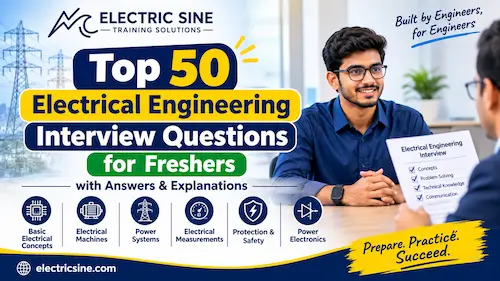
Are you preparing for your first electrical engineering job interview? Whether you are a B.Tech Electrical and Electronics Engineering graduate, a diploma holder, or an aspiring junior electrical engineer, understanding fundamental electrical concepts is essential for performing confidently in technical interviews.
Employers often assess candidates on basic electrical laws, electrical machines, power systems, electrical measurements, protection devices, electrical safety, and practical troubleshooting knowledge.
In this guide, Electric Sine presents 50 important electrical engineering interview questions for freshers with clear answers and explanations.
These questions can help candidates prepare for technical interviews in electrical maintenance, power generation, manufacturing, industrial automation, electrical design, and engineering service companies.
Why Are Electrical Engineering Interview Questions Important for Freshers?
Technical interviews help employers understand how well candidates can apply engineering fundamentals to practical situations.
For freshers, interview preparation should focus on:
- Understanding basic electrical engineering principles.
- Explaining technical concepts clearly.
- Applying electrical formulas correctly.
- Recognizing electrical equipment and protection devices.
- Understanding workplace electrical safety.
- Developing basic troubleshooting skills.
The following questions are organized subject-wise to make preparation easier.
Part 1: Basic Electrical Engineering Interview Questions (1–10)
Q1. What is electricity?
Answer:
Electricity refers to phenomena associated with electric charge, including the movement of charge through a conductor.
In electrical circuits, electric current represents the rate of flow of charge.
The SI unit of electric current is the ampere (A).
Q2. What is the difference between AC and DC?
Answer:
AC stands for Alternating Current, while DC stands for Direct Current.
Alternating Current (AC):
- Changes direction periodically.
- Commonly used in electrical power generation, transmission, and distribution.
- In India, the standard AC supply frequency is 50 Hz.
Direct Current (DC):
- Flows in one direction.
- Commonly supplied by batteries, solar photovoltaic systems, and DC power supplies.
- Used in electronic circuits and various DC-powered equipment.
Q3. What is Ohm's Law?
Answer:
Ohm's Law states that the current flowing through an ohmic conductor is directly proportional to the voltage across it, provided temperature and other physical conditions remain constant.
Formula:
V = I × R
Where:
V = Voltage in volts
I = Current in amperes
R = Resistance in ohms
Example:
If a 10 Ω resistor is connected across a 20 V supply:
Current = Voltage / Resistance
I = 20 / 10 = 2 A
Therefore, the current is 2 A.
Q4. What is the difference between voltage and current?
Answer:
Voltage is the electric potential difference between two points.
Current is the rate at which electric charge flows through a conductor.
Voltage is measured in volts (V), while current is measured in amperes (A).
Q5. What is electrical resistance?
Answer:
Electrical resistance is the opposition offered by a material to the flow of electric current.
Its SI unit is the ohm (Ω).
Resistance depends on factors such as material, length, cross-sectional area, and temperature.
Q6. What is electrical power?
Answer:
Electrical power is the rate at which electrical energy is transferred or converted.
For a DC circuit:
Power = Voltage × Current
P = V × I
For a single-phase AC circuit with sinusoidal voltage and current:
Active Power = Voltage × Current × Power Factor
P = V × I × cos φ
The SI unit of power is the watt (W).
Q7. What is electrical energy?
Answer:
Electrical energy is the total electrical work or energy consumed over a period.
Formula:
Energy = Power × Time
For billing purposes, electrical energy is commonly measured in kilowatt-hours (kWh).
Example:
A 1 kW heater operating for 5 hours consumes:
Energy = 1 × 5 = 5 kWh
Q8. What is the difference between a conductor, insulator, and semiconductor?
Answer:
Conductor: A material that allows electric current to flow relatively easily. Examples include copper and aluminium.
Insulator: A material that strongly resists electric current. Examples include rubber, glass, and porcelain.
Semiconductor: A material whose electrical conductivity can be controlled by doping, temperature, electric fields, or light. Examples include silicon and germanium.
Q9. What are Kirchhoff's Laws?
Answer:
Kirchhoff's Laws are fundamental rules used in electrical circuit analysis.
Kirchhoff's Current Law (KCL):
The algebraic sum of currents at a circuit node is zero.
Total current entering a node equals total current leaving it.
Kirchhoff's Voltage Law (KVL):
The algebraic sum of voltages around a closed circuit loop is zero under the usual lumped-circuit assumptions.
These laws are widely used to analyse electrical networks.
Q10. What is the difference between series and parallel circuits?
Answer:
Series Circuit:
- Components are connected along a single current path.
- The same current flows through all components.
- Total resistance equals the sum of individual resistances.
Parallel Circuit:
- Components are connected across common nodes.
- The voltage across each parallel branch is the same.
- Total current equals the sum of branch currents.
Part 2: Electrical Machines Interview Questions (11–20)
Q11. What is a transformer?
Answer:
A transformer is a static electrical device that transfers AC electrical energy between circuits through electromagnetic induction.
It is commonly used to increase or decrease AC voltage.
A conventional transformer requires changing magnetic flux to induce voltage.
Q12. What is the working principle of a transformer?
Answer:
A transformer works on the principle of mutual electromagnetic induction.
When alternating current flows through the primary winding, it produces changing magnetic flux in the magnetic core.
This changing flux links the secondary winding and induces an EMF.
Q13. What is the difference between a step-up and step-down transformer?
Answer:
Step-Up Transformer:
Increases voltage from the primary side to the secondary side.
The secondary winding has more turns than the primary winding in an ideal transformer.
Step-Down Transformer:
Decreases voltage from the primary side to the secondary side.
The secondary winding has fewer turns than the primary winding.
Q14. Why is a transformer generally rated in kVA instead of kW?
Answer:
Transformers are generally rated in kVA because their thermal loading depends mainly on voltage and current.
Core losses depend largely on voltage and frequency, while copper losses depend on winding current.
The load power factor affects the kW output but is not directly required to specify the transformer's apparent-power rating.
Q15. What is an induction motor?
Answer:
An induction motor is an AC motor in which rotor current is produced by electromagnetic induction.
The stator produces a rotating magnetic field, which induces current in the rotor and develops electromagnetic torque.
Three-phase induction motors are widely used in industrial applications.
Q16. What is slip in an induction motor?
Answer:
Slip is the difference between synchronous speed and rotor speed, expressed relative to synchronous speed.
Formula:
Slip = (Synchronous Speed − Rotor Speed) / Synchronous Speed
s = (Ns − Nr) / Ns
Slip Percentage = s × 100
Example:
If synchronous speed is 1500 rpm and rotor speed is 1440 rpm:
Slip = (1500 − 1440) / 1500
Slip = 60 / 1500 = 0.04
Slip = 4%
Q17. What is synchronous speed?
Answer:
Synchronous speed is the speed of the rotating magnetic field produced by an AC machine's stator.
Formula:
Synchronous Speed = (120 × Frequency) / Number of Poles
Ns = (120 × f) / P
Example:
For a four-pole motor operating at 50 Hz:
Ns = (120 × 50) / 4
Ns = 1500 rpm
Q18. What is the difference between a synchronous motor and an induction motor?
Answer:
Synchronous Motor:
- Operates at synchronous speed when synchronized.
- Requires a suitable rotor excitation or permanent-magnet arrangement.
- Can be used for certain power-factor correction applications.
Induction Motor:
- Normally operates below synchronous speed when producing motoring torque.
- Rotor current is induced electromagnetically.
- Commonly used in industrial drives because of its robust construction.
Q19. Why is a starter required for an electric motor?
Answer:
A motor starter is used to provide controlled starting and appropriate protection.
Depending on the motor type, it may help limit starting current, control starting torque, and provide overload protection.
For DC motors, a starter is especially important because the back EMF is initially zero.
Q20. What are the main losses in a transformer?
Answer:
The main transformer losses include:
Core Losses:
- Hysteresis loss.
- Eddy-current loss.
Winding Losses:
- Copper losses caused by winding resistance.
Additional losses include stray load losses and dielectric losses.
Reducing these losses improves transformer efficiency.
Part 3: Power Systems and Electrical Protection (21–30)
Q21. What is a power system?
Answer:
An electrical power system is a network of equipment used to generate, transmit, distribute, and utilize electrical energy.
Its major components include generators, transformers, transmission lines, substations, distribution networks, and electrical loads.
Q22. Why is electrical power transmitted at high voltage?
Answer:
Electrical power is transmitted at high voltage mainly to reduce current for a given amount of transmitted power.
Lower current reduces resistive losses in transmission conductors.
Copper Loss = I² × R
High-voltage transmission also helps reduce conductor requirements for a given power transfer, subject to insulation, safety, and economic constraints.
Q23. What is a substation?
Answer:
A substation is part of an electrical power system where voltage transformation, switching, protection, control, and monitoring may be performed.
Substations commonly contain transformers, circuit breakers, isolators, busbars, instrument transformers, and protection equipment.
Q24. What is the difference between a circuit breaker and an isolator?
Answer:
Circuit Breaker:
A circuit breaker is designed to make and break electrical current under normal conditions and interrupt fault current within its rated capability.
Isolator:
An isolator provides a visible or otherwise verified isolation point for maintenance.
A conventional isolator is not intended to interrupt fault current.
Q25. What is the difference between a fuse and an MCB?
Answer:
Fuse:
A fuse protects a circuit by melting its fuse element when excessive current flows.
It generally needs replacement after operation.
MCB:
An MCB, or Miniature Circuit Breaker, automatically trips during overload or short-circuit conditions according to its protective characteristics.
It can normally be reset after the fault has been identified and corrected.
Q26. What is earthing?
Answer:
Earthing is the intentional connection of electrical equipment or a system point to earth through an appropriate earthing arrangement.
Protective earthing helps reduce dangerous touch voltages and supports the operation of protective devices under fault conditions.
Earthing is an important part of electrical installation safety.
Q27. What is the difference between earthing and neutral?
Answer:
Neutral:
Neutral is a circuit conductor connected to the neutral point of an electrical system.
It may carry current during normal operation.
Protective Earth:
Protective earth is used for electrical safety by connecting exposed conductive parts to the protective earthing system.
It is not intended to carry normal load current.
Neutral and protective earth must not be treated as interchangeable conductors.
Q28. What is power factor?
Answer:
Power factor is the ratio of active power to apparent power.
Formula:
Power Factor = Active Power / Apparent Power
For sinusoidal voltage and current:
Power Factor = cos φ
Where φ is the phase angle between voltage and current.
Power factor indicates how effectively apparent power is converted into useful active power.
Q29. Why is power factor improvement important?
Answer:
Improving power factor can reduce the current required to supply a given active power.
Benefits may include:
- Reduced resistive losses.
- Reduced voltage drop.
- Improved utilization of electrical equipment capacity.
- Reduced reactive-power-related charges where applicable.
Capacitor banks and other compensation equipment are commonly used for power factor correction.
Q30. What is a protective relay?
Answer:
A protective relay is a device that monitors electrical quantities and detects abnormal operating conditions.
When a specified fault condition is detected, it may issue a trip command to a circuit breaker.
Examples include overcurrent relays, earth-fault relays, differential relays, and distance relays.
Part 4: Electrical Measurements and Instruments (31–38)
Q31. What is the difference between an ammeter and a voltmeter?
Answer:
An ammeter measures electric current and is connected in series with the circuit being measured.
A voltmeter measures potential difference and is connected in parallel across the relevant points.
An ideal ammeter has zero internal resistance, while an ideal voltmeter has infinite internal resistance.
Q32. What is a multimeter?
Answer:
A multimeter is an electrical measuring instrument used to measure quantities such as:
- AC and DC voltage.
- AC and DC current, depending on the model.
- Resistance.
- Continuity.
Some digital multimeters can also measure capacitance, frequency, and temperature.
Q33. What is a megohmmeter?
Answer:
A megohmmeter is an instrument used to measure high resistance, especially electrical insulation resistance.
It is commonly used for testing motors, cables, transformers, and electrical installations.
Insulation testing should be carried out on properly isolated equipment using suitable test procedures.
Q34. What is the difference between CT and PT?
Answer:
Current Transformer (CT):
A current transformer produces a scaled secondary current for measurement and protection.
Potential Transformer (PT):
A potential transformer, also called a voltage transformer, produces a scaled secondary voltage for measurement and protection.
Both are classified as instrument transformers.
Q35. Why should the secondary of a current transformer not be left open while the primary is energized?
Answer:
An open CT secondary can develop a dangerously high voltage.
This can damage insulation, create an electric shock hazard, and affect the magnetic core.
CT secondary circuits must be handled using approved isolation and shorting procedures by qualified personnel.
Q36. What is an energy meter?
Answer:
An energy meter measures the electrical energy consumed by a load or installation over time.
Electrical energy consumption is commonly recorded in kilowatt-hours (kWh).
Modern electronic energy meters may also provide additional electrical measurements and communication features.
Q37. What is the difference between accuracy and precision?
Answer:
Accuracy:
Accuracy describes how close a measurement is to the true or reference value.
Precision:
Precision describes how closely repeated measurements agree with one another.
An instrument may produce highly repeatable readings without necessarily being accurate.
Q38. What is a clamp meter?
Answer:
A clamp meter measures current by sensing the magnetic field associated with a conductor.
It allows current measurement without disconnecting the conductor.
The measurement capability depends on the meter design; some clamp meters measure AC only, while others can measure both AC and DC.
Part 5: Electrical Safety and Practical Interview Questions (39–45)
Q39. What is the difference between overload and short circuit?
Answer:
Overload:
An overload occurs when current exceeds the intended operating capacity of a circuit or equipment without necessarily involving an insulation fault.
Short Circuit:
A short circuit occurs when an unintended low-impedance path allows excessive current to flow between points at different electrical potentials.
Both conditions can cause overheating and equipment damage.
Q40. What is an RCCB?
Answer:
RCCB stands for Residual Current Circuit Breaker.
It detects an imbalance between outgoing and returning current and disconnects the circuit when the residual current exceeds its operating threshold.
An RCCB provides residual-current protection but does not inherently provide overload or short-circuit protection.
Appropriate overcurrent protection is also required.
Q41. What is the difference between an MCB and an RCCB?
Answer:
MCB:
Protects against overload and short-circuit current.
RCCB:
Protects against residual-current faults by detecting current imbalance.
Both devices perform different protective functions.
An RCBO combines residual-current protection and overcurrent protection in one device.
Q42. What is the purpose of a capacitor bank?
Answer:
A capacitor bank is commonly used for reactive power compensation and power factor improvement.
In installations with inductive loads, capacitors supply leading reactive power and reduce the net lagging reactive power drawn from the supply.
Q43. What is preventive maintenance?
Answer:
Preventive maintenance involves planned inspection, testing, cleaning, servicing, and replacement activities intended to reduce equipment failures.
Examples include:
- Inspecting electrical connections.
- Checking insulation condition.
- Monitoring abnormal temperature rise.
- Inspecting motor bearings.
- Testing protective equipment according to approved procedures.
Q44. What is a single-line diagram?
Answer:
A single-line diagram, or SLD, is a simplified representation of an electrical power system.
It uses standard symbols and a single line to represent the main electrical connections and equipment.
SLDs are widely used for electrical design, operation, maintenance, and troubleshooting.
Q45. What safety precautions should be followed before working on electrical equipment?
Answer:
Before electrical maintenance work, qualified personnel should follow an approved safe-work procedure.
Important steps include:
- Identify the equipment and all possible energy sources.
- Properly isolate the equipment.
- Apply lockout/tagout procedures where required.
- Verify absence of voltage using an appropriately rated tester and approved procedure.
- Address stored electrical or mechanical energy.
- Use suitable personal protective equipment and tools.
- Follow applicable site safety rules and authorization requirements.
Electrical work should never begin merely because a switch appears to be OFF.
Part 6: Practical and HR-Related Electrical Interview Questions (46–50)
Q46. Why does a three-phase induction motor rotate in the opposite direction when two supply phases are interchanged?
Answer:
Interchanging any two phases reverses the phase sequence of a three-phase supply.
This reverses the direction of the rotating magnetic field produced by the stator.
As a result, the motor's direction of rotation reverses.
Q47. What are common reasons for overheating in an electrical motor?
Answer:
Common causes include:
- Excessive mechanical load.
- Unbalanced supply voltage.
- Single phasing.
- Poor ventilation.
- Bearing problems.
- Incorrect supply conditions.
- Frequent starting.
- Winding faults.
The actual cause should be identified through appropriate inspection and testing by qualified personnel.
Q48. What would you check if a three-phase motor fails to start?
Answer:
A systematic troubleshooting approach may include:
- Checking supply availability and voltage.
- Checking protective device status.
- Checking control circuit conditions.
- Inspecting contactors and overload protection.
- Checking for mechanical jamming.
- Reviewing motor nameplate requirements.
- Conducting appropriate winding and insulation tests after safe isolation.
Troubleshooting must follow approved electrical safety procedures.
Q49. How would you explain your final-year electrical engineering project in an interview?
Answer:
A good project explanation should cover:
- Project title.
- Problem or objective.
- Main components or technologies used.
- Working principle.
- Your individual contribution.
- Testing and results.
- Challenges faced and lessons learned.
Example response:
"My final-year project focused on an automatic power factor correction system. The objective was to monitor the power factor and control capacitor switching based on reactive power requirements. My role involved circuit design, component selection, testing, and documentation. The project helped me understand power factor correction and practical electrical measurement."
Candidates should replace this example with their actual project experience.
Q50. Why should we hire you as a fresher electrical engineer?
Answer:
This question evaluates technical confidence, communication, willingness to learn, and professional attitude.
Sample Answer:
"As a fresher electrical engineer, I have a strong foundation in electrical circuits, machines, power systems, and electrical safety. I am interested in applying my technical knowledge to practical engineering work. I am willing to learn new technologies, follow safety procedures, and contribute responsibly to the team. I believe my technical fundamentals and commitment to continuous learning will help me grow in this role."
Candidates should personalize this answer based on their qualifications and experience.
Important Electrical Engineering Formulas for Interviews
Interviewers may ask candidates to explain or apply common electrical formulas.
| Formula | Expression |
|---|---|
| Ohm's Law | V = I × R |
| DC Power | P = V × I |
| Resistive Power | P = I² × R |
| Electrical Energy | E = P × t |
| Synchronous Speed | Ns = (120 × f) / P |
| Induction Motor Slip | s = (Ns − Nr) / Ns |
| Single-Phase Active Power | P = V × I × cos φ |
| Balanced Three-Phase Active Power | P = √3 × VL × IL × cos φ |
| Power Factor | PF = Active Power / Apparent Power |
| Transformer Voltage Ratio | V1 / V2 ≈ N1 / N2 |
Note: The AC power formulas shown assume sinusoidal operating conditions, and the transformer voltage ratio is an ideal or approximate relationship.
How to Prepare for an Electrical Engineering Interview as a Fresher
A structured preparation strategy can improve technical knowledge and interview confidence.
1. Revise Fundamental Electrical Concepts
Focus on Ohm's Law, Kirchhoff's Laws, AC and DC circuits, power calculations, and three-phase systems.
2. Understand Electrical Machines
Revise transformers, induction motors, synchronous motors, DC machines, motor starters, and machine losses.
3. Learn Electrical Safety and Protection
Understand earthing, MCBs, RCCBs, circuit breakers, relays, and safe isolation procedures.
4. Prepare Practical Examples
Interviewers may ask about motor faults, power factor correction, electrical maintenance, and basic troubleshooting.
5. Revise Your Academic Project
Be ready to explain the purpose, working principle, components, results, and your contribution to your final-year project.
6. Practise Technical Questions Regularly
Use topic-wise practice questions and mock tests to strengthen your knowledge and identify areas requiring revision.
7. Improve Communication Skills
Try to explain technical concepts using clear language and simple examples.
Avoid memorizing answers without understanding the underlying concepts.
Frequently Asked Questions
What are the most common electrical engineering interview questions for freshers?
Common questions cover Ohm's Law, AC and DC, transformers, induction motors, power factor, earthing, circuit breakers, electrical measurements, and basic troubleshooting.
Are these questions suitable for diploma electrical engineering students?
Yes. These questions cover many fundamental concepts relevant to diploma electrical engineering students and entry-level technical interviews.
Are electrical engineering interviews difficult for freshers?
The difficulty depends on the job role and employer. Many entry-level interviews emphasize engineering fundamentals, practical understanding, electrical safety, and the candidate's academic project.
How should I prepare for an electrical maintenance interview?
Focus on electrical machines, motor starters, protective devices, measuring instruments, preventive maintenance, safe isolation, and basic troubleshooting concepts.
Are these questions useful for government engineering job interviews?
They can help strengthen technical fundamentals relevant to many engineering roles. Candidates should also prepare for the specific recruitment syllabus, interview requirements, and job responsibilities.
Conclusion
Preparing for an electrical engineering interview requires more than memorizing definitions.
Freshers should understand fundamental electrical principles, practise technical questions, develop practical awareness, and communicate their knowledge clearly.
These Top 50 Electrical Engineering Interview Questions for Freshers with Answers provide a structured starting point for technical interview preparation.
Continue improving your electrical engineering knowledge with topic-wise practice questions, technical explanations, and learning resources from Electric Sine.
Learn. Practice. Prepare.
Visit: https://electricsine.com