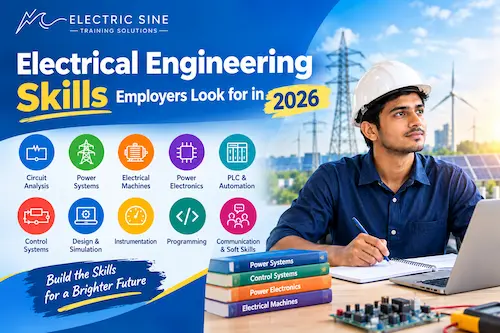
However, having a degree alone may not always be enough to build a successful career. Employers increasingly look for candidates who have a combination of strong electrical engineering fundamentals, practical knowledge, problem-solving ability, software skills, and industry awareness.
For B.Tech, B.E., Diploma students, fresh graduates, and job seekers, developing the right skills can make a significant difference when applying for internships and electrical engineering jobs.
In this article, let us explore the important electrical engineering skills employers look for in 2026 and how students can become more job-ready.
Why Are Electrical Engineering Skills Important?
Electrical engineering involves both theoretical concepts and practical applications. Engineers may need to analyze circuits, understand electrical machines, work with power systems, troubleshoot equipment, design electrical systems, or operate automated industrial processes.
Companies therefore look for candidates who can apply their academic knowledge to real-world engineering problems.
A student who understands the theory and can also analyze a practical problem is more likely to stand out during interviews and technical assessments.
1. Strong Electrical Engineering Fundamentals
A strong foundation is one of the most important requirements for an electrical engineering career.
Students should have a clear understanding of subjects such as:
- Electrical Circuits
- Electrical Machines
- Power Systems
- Power Electronics
- Control Systems
- Measurements and Instrumentation
- Signals and Systems
- Digital and Analog Electronics
- Electromagnetic Theory
These fundamentals are useful not only for examinations but also for technical interviews and real-world engineering applications.
Instead of memorizing formulas, students should focus on understanding how and why electrical systems work.
2. Circuit Analysis Skills
Circuit analysis is a fundamental skill for electrical and electronics engineers.
Students should be comfortable with concepts such as:
- Ohm's Law
- Kirchhoff's Laws
- Network Theorems
- AC and DC circuit analysis
- RLC circuits
- Resonance
- Transient analysis
- Three-phase circuits
Being able to analyze a circuit systematically can help students solve technical questions more confidently.
Circuit analysis also provides the foundation for understanding more advanced electrical and electronic systems.
3. Knowledge of Electrical Machines
Electrical machines are highly relevant to many engineering industries.
Students should understand the operating principles and characteristics of:
- DC Motors and Generators
- Transformers
- Induction Motors
- Synchronous Machines
- Special Electrical Machines
Important areas include construction, working principle, equivalent circuits, losses, efficiency, starting methods, speed control, and applications.
A strong understanding of electrical machines can be particularly useful for careers related to power generation, manufacturing, industrial systems, maintenance, and electrical equipment.
4. Power Systems Knowledge
Power systems are another major area of electrical engineering.
Students interested in power-sector careers should understand:
- Power generation
- Transmission and distribution
- Power factor
- Fault analysis
- Circuit breakers
- Protective relays
- Substations
- Transmission lines
- Load flow basics
- Power system stability
Understanding how electrical power moves from generation stations to consumers provides an important foundation for many electrical engineering roles.
5. Power Electronics
Power electronics has become increasingly important because of applications such as electric vehicles, renewable energy systems, industrial drives, battery systems, and energy-efficient equipment.
Students should understand devices and converters such as:
- Diodes
- SCRs
- MOSFETs
- IGBTs
- Rectifiers
- Inverters
- Choppers
- AC voltage controllers
Understanding the operation and applications of power electronic converters can provide an advantage for students interested in modern electrical technologies.
6. PLC and Industrial Automation
Industrial automation is an important career area for electrical engineers.
Knowledge of Programmable Logic Controllers (PLC) can be valuable for students interested in manufacturing and industrial automation.
Basic knowledge of:
- PLC programming
- Sensors
- Actuators
- Industrial control
- Motor control
- HMI
- SCADA
- Industrial communication
can help students understand how automated industrial systems operate.
Practical exposure to automation technologies can also strengthen a candidate's technical profile.
7. Control Systems
Control systems are used in many engineering applications, from industrial machines to robotics and automation.
Students should understand concepts such as:
- Open-loop and closed-loop systems
- Transfer functions
- Block diagrams
- Feedback
- Stability
- Time response
- Frequency response
- PID controllers
Control-system knowledge is especially useful for careers involving automation, robotics, instrumentation, and industrial control.
8. Electrical Design and Simulation Skills
Modern electrical engineers often use software tools to analyze and design systems.
Depending on the career path, students can develop familiarity with tools used for:
- Circuit simulation
- Electrical system design
- Power system analysis
- Control-system simulation
- PCB design
- Electrical drawings
Learning relevant engineering software alongside theoretical concepts can help students understand how engineering problems are solved in professional environments.
9. Troubleshooting and Problem-Solving Ability
Employers do not only look for candidates who can answer theoretical questions.
They also want engineers who can identify problems and find practical solutions.
For example, an engineer may need to determine why:
- A motor is overheating
- A circuit is not working
- A protective device is repeatedly tripping
- A control system is malfunctioning
- An electrical machine is producing abnormal noise
- A system is consuming excessive power
Developing a structured troubleshooting approach can therefore be extremely valuable.
10. Basic Programming Knowledge
Programming is becoming increasingly useful across engineering disciplines.
Electrical engineering students can benefit from learning basic programming concepts and languages such as:
- Python
- C
- MATLAB programming
- PLC programming
Programming can be useful for data analysis, automation, simulation, control applications, testing, and engineering calculations.
Students do not necessarily need to become software developers. Instead, they should understand how programming can support engineering work.
11. Renewable Energy Knowledge
The growth of renewable energy is creating new areas of opportunity for electrical engineers.
Students can develop basic knowledge of:
- Solar photovoltaic systems
- Wind energy systems
- Battery energy storage
- Grid-connected systems
- Inverters
- Energy management
- Electric vehicles
- Smart grids
Renewable energy knowledge can complement traditional electrical engineering fundamentals and help students understand emerging industry trends.
12. Electrical Measurements and Instrumentation
Accurate measurement is essential in electrical engineering.
Students should understand commonly used measuring instruments and concepts such as:
- Voltage measurement
- Current measurement
- Power measurement
- Energy measurement
- Sensors
- Transducers
- Measurement errors
- Calibration
Instrumentation knowledge can be useful in industries involving manufacturing, process control, testing, automation, and electrical maintenance.
13. Communication and Technical Documentation
Technical knowledge alone is not enough for a successful engineering career.
Electrical engineers often need to communicate technical information with engineers, technicians, managers, clients, and other teams.
Students should therefore improve:
- Technical communication
- Report writing
- Presentation skills
- Documentation
- Team communication
Being able to explain a technical concept clearly is a valuable professional skill.
14. Practical Learning Matters
One of the biggest differences between academic learning and professional engineering is practical application.
Students should try to gain practical exposure through:
- Laboratory experiments
- Mini projects
- Final-year projects
- Internships
- Simulation projects
- Industrial visits
- Technical workshops
For example, instead of only studying a motor theoretically, students can try to understand its starting method, speed control, protection, efficiency, and practical applications.
This type of learning helps connect theory with real-world engineering.
How Can Electrical Engineering Students Become Job-Ready?
Students can follow a simple approach to improve their technical profile.
Step 1: Strengthen the Fundamentals
Start with core subjects and make sure the basic concepts are clear.
Step 2: Practice Technical Questions
Solve objective questions and previous examination questions regularly. This helps improve both conceptual understanding and problem-solving speed.
Step 3: Learn Practical Applications
Try to understand how theoretical concepts are used in electrical systems, machines, automation, and industries.
Step 4: Learn Relevant Tools
Choose software and technologies based on your career interests.
For example:
Power sector: Power system analysis and protection
Automation: PLC, SCADA and control systems
Renewable energy: Solar PV, inverters and energy storage
Electrical design: Electrical drawing and design tools
Step 5: Build Projects
A practical project can demonstrate your ability to apply engineering concepts.
Step 6: Prepare for Technical Interviews
Review important concepts and practice explaining them clearly.
Electrical Engineering Skills for Different Career Paths
Different electrical engineering careers require different combinations of skills.
| Career Area | Useful Skills |
|---|---|
| Power Systems | Power systems, protection, substations |
| Electrical Maintenance | Machines, troubleshooting, safety |
| Industrial Automation | PLC, SCADA, sensors, control systems |
| Renewable Energy | Solar PV, inverters, batteries |
| Electrical Design | Circuit design, drawings, simulation |
| Instrumentation | Sensors, measurements, control |
| Electrical Manufacturing | Machines, testing, quality control |
| Electric Vehicles | Motors, power electronics, batteries |
| Research & Development | Simulation, programming, advanced fundamentals |
Students should therefore avoid trying to learn everything at once. It is better to build strong fundamentals and then develop specialized skills according to their career goals.
How Online Learning Can Help Electrical Engineering Students
Online learning can help students study technical subjects at their own pace.
An effective learning platform can provide:
- Concept-based lessons
- Practice questions
- Mock tests
- Objective questions
- Technical quizzes
- Previous-year questions
- Explanations
- Exam-oriented preparation
Platforms such as Electric Sine can help electrical engineering, electronics engineering, and instrumentation students strengthen their technical knowledge through structured learning and regular practice.
Frequently Asked Questions
What are the most important skills for electrical engineers?
Strong fundamentals in electrical engineering, problem-solving, practical knowledge, troubleshooting, electrical design, automation, and communication are among the most useful skills.
Is PLC knowledge useful for electrical engineering students?
Yes. PLC knowledge can be particularly useful for students interested in industrial automation, manufacturing, control systems, and maintenance.
Should electrical engineering students learn programming?
Basic programming can be beneficial. Python, C, MATLAB, and PLC programming can support engineering analysis, automation, simulation, and data-related tasks.
Are practical skills important for fresh electrical engineering graduates?
Yes. Practical knowledge can help graduates demonstrate that they can apply theoretical concepts to real engineering problems.
How can students improve their electrical engineering knowledge?
Students can combine textbook learning with practice questions, laboratory work, projects, simulations, technical quizzes, mock tests, internships, and online learning.
Conclusion
The electrical engineering industry is continuously evolving. Traditional knowledge of circuits, machines, power systems, and control remains important, while emerging areas such as automation, renewable energy, electric vehicles, power electronics, and smart technologies are creating new opportunities.
For students and job seekers, the best approach is to build a strong foundation and gradually add practical and industry-relevant skills.
Learn the concepts. Practice regularly. Build practical skills. Keep learning.
With the right combination of knowledge, practice, and practical exposure, electrical engineering students can become better prepared for internships, technical interviews, competitive examinations, and future career opportunities.