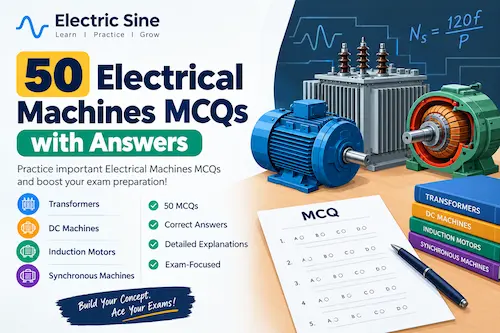
Electrical Machines is one of the important subjects for Electrical Engineering competitive examinations. It covers the working principles, construction, performance and applications of transformers, DC machines, induction motors and synchronous machines.
Candidates preparing for examinations such as GATE EE, SSC JE Electrical, RRB JE Electrical, UPSC ESE and various state-level engineering recruitment examinations should develop a strong understanding of Electrical Machines concepts.
Practising multiple-choice questions (MCQs) can help you revise important concepts, improve numerical problem-solving skills and identify areas that require further study.
In this article, we have compiled 50 important Electrical Machines MCQs with answers and explanations covering fundamental concepts, operating principles, formulas and practical applications.
Try answering each question before checking the correct answer.
Section 1: Basic Electrical Machines
1. What is the main operating principle of a transformer?
A. Electrostatic induction
B. Mutual electromagnetic induction
C. Chemical reaction
D. Thermal conduction
Correct Answer: B. Mutual electromagnetic induction
Explanation: A transformer transfers electrical energy from one circuit to another through mutual electromagnetic induction. An alternating current in the primary winding produces a changing magnetic flux, which induces an EMF in the secondary winding.
2. Which type of electrical machine converts mechanical energy into electrical energy?
A. Electric motor
B. Transformer
C. Electric generator
D. Rectifier
Correct Answer: C. Electric generator
Explanation: An electrical generator converts mechanical energy into electrical energy through electromagnetic induction. The mechanical input may come from a turbine, engine or another prime mover.
3. Which of the following machines operates on DC supply?
A. DC motor
B. Three-phase induction motor
C. Synchronous motor
D. Alternator
Correct Answer: A. DC motor
Explanation: A DC motor operates using direct-current electrical supply. A commutator in a conventional DC motor helps maintain unidirectional torque.
4. What is the function of a commutator in a DC generator?
A. Increase the supply frequency
B. Convert the internally generated alternating EMF into unidirectional output
C. Reduce the magnetic flux to zero
D. Increase the number of poles
Correct Answer: B. Convert the internally generated alternating EMF into unidirectional output
Explanation: The armature conductors of a DC generator generate alternating EMF as they rotate. The commutator acts as a mechanical rectifier, producing a unidirectional output at the brushes.
5. Which material is commonly used for transformer cores?
A. Copper
B. Aluminium
C. Laminated silicon steel
D. Plastic
Correct Answer: C. Laminated silicon steel
Explanation: Laminated silicon steel provides a suitable magnetic path and helps reduce eddy-current losses. The laminations electrically isolate adjacent layers, limiting circulating currents in the core.
6. What is the synchronous speed of an AC machine?
A. (N_s = 60f/P)
B. (N_s = 120f/P)
C. (N_s = P/120f)
D. (N_s = 120P/f)
Correct Answer: B. (N_s = 120f/P)
Explanation: Synchronous speed is calculated using:
[
N_s=\frac{120f}{P}
]
where (N_s) is in RPM, (f) is the supply frequency in hertz, and (P) is the number of poles.
7. Which electrical machine is commonly used to generate three-phase AC power in power stations?
A. DC series motor
B. Alternator
C. Transformer
D. DC shunt motor
Correct Answer: B. Alternator
Explanation: An alternator is a synchronous generator that converts mechanical energy into alternating electrical energy. Three-phase alternators are widely used in power generation.
8. Which of the following is a static electrical machine?
A. DC motor
B. Induction motor
C. Transformer
D. Synchronous motor
Correct Answer: C. Transformer
Explanation: A transformer has no rotating parts and transfers electrical energy through electromagnetic induction. Motors and generators are generally classified as rotating electrical machines.
9. What is the primary function of an electric motor?
A. Convert electrical energy into mechanical energy
B. Convert mechanical energy into heat only
C. Increase electrical frequency
D. Store electrical energy chemically
Correct Answer: A. Convert electrical energy into mechanical energy
Explanation: An electric motor converts electrical input into mechanical output. Motors are used in pumps, fans, compressors, industrial drives and many other applications.
10. Which law explains the direction of induced EMF in a generator?
A. Ohm's law
B. Faraday's law only
C. Lenz's law
D. Coulomb's law
Correct Answer: C. Lenz's law
Explanation: Faraday's law describes the magnitude of induced EMF, while Lenz's law determines its direction. The induced effect opposes the change in magnetic flux responsible for producing it.
Section 2: Transformer MCQs
11. A transformer operates on which type of supply under normal operating conditions?
A. Pure DC
B. AC
C. Static charge only
D. Mechanical supply
Correct Answer: B. AC
Explanation: A transformer requires changing magnetic flux to induce EMF. A steady DC supply does not produce continuous transformer action and can cause excessive primary current after the transient.
12. What is the turns ratio of an ideal transformer?
A. (N_1/N_2=V_1/V_2)
B. (N_1/N_2=V_2/V_1)
C. (N_1/N_2=I_1/I_2)
D. (N_1/N_2=V_1I_1)
Correct Answer: A. (N_1/N_2=V_1/V_2)
Explanation: For an ideal transformer, the voltage ratio equals the turns ratio:
[
\frac{V_1}{V_2}=\frac{N_1}{N_2}
]
Here, (N_1) and (N_2) are the primary and secondary turns, respectively.
13. A transformer has 1,000 primary turns and 200 secondary turns. If the primary voltage is 250 V, what is the ideal secondary voltage?
A. 25 V
B. 50 V
C. 125 V
D. 500 V
Correct Answer: B. 50 V
Explanation:
[
V_2=V_1\frac{N_2}{N_1}
]
[
V_2=250\times\frac{200}{1000}=50\text{ V}
]
Therefore, the ideal secondary voltage is 50 V.
14. Which transformer loss varies approximately with the square of load current?
A. Hysteresis loss
B. Eddy-current loss
C. Copper loss
D. Dielectric loss
Correct Answer: C. Copper loss
Explanation: Winding copper loss is given by:
[
P_{cu}=I^2R
]
For a constant winding resistance, copper loss increases approximately with the square of current.
15. Which test is commonly used to determine the core loss of a transformer?
A. Short-circuit test only
B. Open-circuit test
C. Load test at maximum current only
D. Polarity test
Correct Answer: B. Open-circuit test
Explanation: In the open-circuit test, rated voltage is usually applied to one winding while the other winding remains open. The measured input power approximately represents core loss because the no-load current is relatively small.
16. Which test is commonly used to determine the equivalent series impedance and full-load copper loss of a transformer?
A. Open-circuit test
B. Short-circuit test
C. Polarity test
D. Insulation resistance test only
Correct Answer: B. Short-circuit test
Explanation: In the short-circuit test, a low voltage is applied to circulate the required test current. At rated current, the measured input power approximately represents full-load copper loss.
17. What is the frequency of the secondary voltage of an ideal transformer supplied at 50 Hz?
A. 25 Hz
B. 50 Hz
C. 100 Hz
D. Depends on the turns ratio
Correct Answer: B. 50 Hz
Explanation: A transformer changes voltage and current levels but does not change the supply frequency. Therefore, the secondary frequency remains 50 Hz.
18. Which transformer is used to increase voltage from the primary to the secondary?
A. Step-down transformer
B. Step-up transformer
C. Isolation transformer in every case
D. Current transformer only
Correct Answer: B. Step-up transformer
Explanation: A step-up transformer has more turns in the secondary winding than in the primary winding. For an ideal transformer, the secondary voltage is higher than the primary voltage.
19. What is the condition for maximum efficiency of a transformer?
A. Copper loss is zero
B. Core loss is zero
C. Copper loss equals core loss
D. Output power is zero
Correct Answer: C. Copper loss equals core loss
Explanation: For a transformer operating at a given voltage and frequency, maximum efficiency occurs when variable copper loss equals approximately constant core loss.
20. Why is transformer oil used in many oil-immersed transformers?
A. To increase supply frequency
B. To provide insulation and assist cooling
C. To act as the primary winding
D. To eliminate all losses
Correct Answer: B. To provide insulation and assist cooling
Explanation: Transformer oil provides dielectric insulation and transfers heat away from the core and windings. Oil condition and cooling arrangements are important for reliable operation.
Section 3: DC Machines MCQs
21. Which type of DC motor is known for high starting torque?
A. DC series motor
B. DC shunt motor
C. Separately excited DC motor under all conditions
D. Synchronous motor
Correct Answer: A. DC series motor
Explanation: In a DC series motor, the field winding is connected in series with the armature. Before magnetic saturation, the starting torque is approximately proportional to the square of armature current, giving high starting torque.
22. Which DC motor is commonly associated with approximately constant speed under varying loads?
A. DC series motor
B. DC shunt motor
C. Universal motor only
D. Single-phase induction motor
Correct Answer: B. DC shunt motor
Explanation: The shunt field is connected across the supply, so its flux is approximately constant. This allows the motor to maintain relatively stable speed over a normal operating load range.
23. What is the function of the back EMF in a DC motor?
A. It assists the supply voltage in driving armature current
B. It opposes the applied armature voltage
C. It increases the supply frequency
D. It eliminates mechanical losses
Correct Answer: B. It opposes the applied armature voltage
Explanation: As the armature rotates, it generates an EMF that opposes the applied voltage. This back EMF limits the armature current during normal operation.
24. Why is a starter required for many conventional DC motors?
A. To increase the number of poles
B. To limit the high initial armature current
C. To reverse the supply frequency
D. To eliminate field flux
Correct Answer: B. To limit the high initial armature current
Explanation: At starting, the motor speed and back EMF are approximately zero. Because the armature resistance is low, direct application of rated voltage can cause excessive current. A starter limits this current.
25. Which equation represents the generated EMF of a DC generator?
A. (E_g=P\Phi ZN/(60A))
B. (E_g=60A/(P\Phi ZN))
C. (E_g=V/I)
D. (E_g=I^2R)
Correct Answer: A. (E_g=P\Phi ZN/(60A))
Explanation: The generated EMF is:
[
E_g=\frac{P\Phi ZN}{60A}
]
where (P) is the number of poles, (\Phi) is flux per pole in webers, (Z) is the total number of armature conductors, (N) is speed in RPM, and (A) is the number of parallel paths.
26. Which DC generator is commonly used where a nearly constant terminal voltage is required over a normal load range?
A. DC shunt generator
B. DC series generator in all applications
C. Separately excited generator with no voltage control
D. Permanent-magnet motor
Correct Answer: A. DC shunt generator
Explanation: A DC shunt generator can provide a relatively stable terminal voltage over a suitable operating range. Its actual voltage regulation depends on armature resistance, armature reaction and load.
27. What happens to the speed of a DC motor if the flux decreases while the back EMF remains approximately constant?
A. Speed decreases to zero
B. Speed increases
C. Speed remains exactly constant
D. Direction must reverse
Correct Answer: B. Speed increases
Explanation: Motor speed is approximately proportional to back EMF divided by flux:
[
N\propto\frac{E_b}{\Phi}
]
If flux decreases while back EMF remains approximately constant, speed increases. Excessive field weakening can cause dangerous overspeed.
28. Which method is commonly used to control the speed of a DC shunt motor above its base speed?
A. Field weakening
B. Increasing the number of poles mechanically
C. Increasing transformer frequency
D. Removing the commutator
Correct Answer: A. Field weakening
Explanation: Reducing the field current weakens the magnetic flux. This can increase motor speed above its base speed, subject to commutation, torque and mechanical limitations.
29. What is armature reaction in a DC machine?
A. The effect of armature flux on the main field flux
B. The heating effect of transformer oil
C. The increase in supply frequency
D. The mechanical action of the shaft only
Correct Answer: A. The effect of armature flux on the main field flux
Explanation: Armature current produces its own magnetic field. This field distorts and may weaken the main field distribution, affecting commutation and machine performance.
30. Which part of a conventional DC machine carries the armature winding?
A. Yoke only
B. Armature core
C. Brush holder only
D. Bearing housing
Correct Answer: B. Armature core
Explanation: The armature winding is placed in slots in the armature core. The core provides a magnetic path and is generally laminated to reduce eddy-current losses.
Section 4: Induction Motor MCQs
31. What is the synchronous speed of a four-pole induction motor supplied at 50 Hz?
A. 750 RPM
B. 1,000 RPM
C. 1,500 RPM
D. 3,000 RPM
Correct Answer: C. 1,500 RPM
Explanation:
[
N_s=\frac{120f}{P}
=\frac{120\times50}{4}
=1500\text{ RPM}
]
32. What is the slip of an induction motor operating at synchronous speed?
A. 0
B. 0.5
C. 1
D. 100
Correct Answer: A. 0
Explanation: Slip is defined as:
[
s=\frac{N_s-N_r}{N_s}
]
At synchronous speed, rotor speed equals synchronous speed, so slip is zero. In an induction motor operating as a motor under normal conditions, positive slip is required to induce rotor current and produce torque.
33. A four-pole, 50 Hz induction motor runs at 1,440 RPM. What is its slip?
A. 2%
B. 4%
C. 6%
D. 8%
Correct Answer: B. 4%
Explanation: The synchronous speed is 1,500 RPM.
[
s=\frac{1500-1440}{1500}=0.04
]
Therefore, the slip is 4%.
34. Which type of rotor is widely used in industrial three-phase induction motors because of its simple and robust construction?
A. Squirrel-cage rotor
B. Commutator rotor
C. Salient-pole rotor
D. Wound DC armature only
Correct Answer: A. Squirrel-cage rotor
Explanation: A squirrel-cage rotor consists of conducting bars short-circuited by end rings. Its robust construction and low maintenance requirements make it widely used in industrial applications.
35. What is the rotor frequency of an induction motor at standstill?
A. Zero
B. Equal to the stator supply frequency
C. Twice the stator supply frequency
D. Independent of the supply frequency
Correct Answer: B. Equal to the stator supply frequency
Explanation: Rotor frequency is:
[
f_r=sf
]
At standstill, slip (s=1), so rotor frequency equals the stator supply frequency.
36. Which method is commonly used to control the speed of a three-phase induction motor efficiently?
A. Changing supply frequency using a variable-frequency drive
B. Increasing rotor resistance in every type of rotor
C. Removing the stator winding
D. Changing the shaft material
Correct Answer: A. Changing supply frequency using a variable-frequency drive
Explanation: A variable-frequency drive adjusts the supply frequency and usually the voltage to control motor speed. This is widely used for pumps, fans, conveyors and industrial drives.
37. What is the approximate synchronous speed of a six-pole, 50 Hz induction motor?
A. 500 RPM
B. 750 RPM
C. 1,000 RPM
D. 1,500 RPM
Correct Answer: C. 1,000 RPM
Explanation:
[
N_s=\frac{120\times50}{6}=1000\text{ RPM}
]
38. Why does a three-phase induction motor require slip to produce torque in normal motoring operation?
A. To increase the number of stator poles
B. To induce rotor EMF and rotor current
C. To stop the rotating magnetic field
D. To eliminate the air gap
Correct Answer: B. To induce rotor EMF and rotor current
Explanation: Relative motion between the rotating magnetic field and the rotor induces rotor EMF and current. Their interaction with the magnetic field produces electromagnetic torque.
39. Which induction motor is commonly used for small domestic applications such as fans and some pumps?
A. Single-phase induction motor
B. Three-phase synchronous generator
C. DC series generator
D. Transformer
Correct Answer: A. Single-phase induction motor
Explanation: Single-phase induction motors are widely used in domestic and small commercial equipment. Many designs require an auxiliary winding or another starting arrangement to develop starting torque.
40. What is the main purpose of a star-delta starter for a suitable three-phase induction motor?
A. Increase starting current
B. Reduce starting current
C. Increase supply frequency
D. Eliminate the need for motor protection
Correct Answer: B. Reduce starting current
Explanation: During star starting, each winding receives a lower voltage than it would in delta connection at the same line voltage. For the same motor and supply conditions, the starting line current is approximately one-third of direct-on-line delta starting current. Starting torque is also reduced to approximately one-third.
Section 5: Synchronous Machines MCQs
41. Which type of machine is commonly used as an alternator in power stations?
A. Synchronous generator
B. DC series motor
C. Single-phase transformer
D. Squirrel-cage induction motor operating as a motor
Correct Answer: A. Synchronous generator
Explanation: A synchronous generator converts mechanical input into AC electrical power. Its rotor magnetic field rotates in synchronism with the generated electrical frequency.
42. What is the synchronous speed of a two-pole, 50 Hz synchronous machine?
A. 750 RPM
B. 1,000 RPM
C. 1,500 RPM
D. 3,000 RPM
Correct Answer: D. 3,000 RPM
Explanation:
[
N_s=\frac{120\times50}{2}=3000\text{ RPM}
]
43. Which part of a conventional alternator usually carries the three-phase armature winding?
A. Rotor
B. Stator
C. Shaft only
D. Bearings
Correct Answer: B. Stator
Explanation: In a typical alternator, the three-phase armature winding is placed on the stator, while the rotor carries the field system. This arrangement simplifies insulation and connection of high-voltage output windings.
44. What is the function of the excitation system in a synchronous generator?
A. Supply field current to establish the rotor magnetic field
B. Increase the number of stator slots during operation
C. Convert AC directly into mechanical energy
D. Eliminate all copper losses
Correct Answer: A. Supply field current to establish the rotor magnetic field
Explanation: The excitation system supplies or controls the rotor field current. In a grid-connected generator, excitation control is important for regulating terminal voltage and reactive power.
45. Which instrument is commonly used to measure the frequency of an AC supply?
A. Frequency meter
B. Megger only
C. Watt-hour meter only
D. Earth electrode
Correct Answer: A. Frequency meter
Explanation: A frequency meter measures the number of AC cycles per second, expressed in hertz (Hz). Frequency is an important operating parameter in power systems.
46. Which condition is essential before connecting an alternator in parallel with an existing AC busbar?
A. Equal voltage magnitude only
B. Equal frequency only
C. Correct phase sequence, approximately equal voltage and frequency, and suitable phase-angle alignment
D. Zero excitation current under all conditions
Correct Answer: C. Correct phase sequence, approximately equal voltage and frequency, and suitable phase-angle alignment
Explanation: Synchronising an alternator requires the correct phase sequence and matching voltage and frequency, with the phase angle suitably aligned at the instant of connection. Incorrect synchronisation can produce severe electrical and mechanical stresses.
47. What is the main function of a synchronous condenser?
A. Improve power factor by supplying or absorbing reactive power
B. Convert DC directly into heat
C. Reduce the number of poles in a generator
D. Measure winding resistance only
Correct Answer: A. Improve power factor by supplying or absorbing reactive power
Explanation: An overexcited synchronous motor operating without mechanical load can supply reactive power to the system. A synchronous condenser is used for power-factor improvement and voltage support.
48. What happens to the synchronous speed of a synchronous motor if the supply frequency increases while the number of poles remains constant?
A. It decreases
B. It increases
C. It becomes zero
D. It remains unchanged
Correct Answer: B. It increases
Explanation: Synchronous speed is:
[
N_s=\frac{120f}{P}
]
With a constant number of poles, synchronous speed increases directly with supply frequency.
49. Which statement about a synchronous motor operating under normal steady-state conditions is correct?
A. Its speed is determined by supply frequency and number of poles
B. Its speed always decreases significantly when load increases
C. It must operate with a slip of 5%
D. It cannot operate from AC supply
Correct Answer: A. Its speed is determined by supply frequency and number of poles
Explanation: A synchronous motor runs at synchronous speed under normal steady-state operation. Increasing the mechanical load changes the torque angle within the stable operating range, rather than producing the slip characteristic of an induction motor.
50. Which of the following is an important application of synchronous motors?
A. Constant-speed industrial drives
B. Voltage transformation without moving parts
C. Rectification of AC using a diode bridge
D. Chemical energy storage
Correct Answer: A. Constant-speed industrial drives
Explanation: Synchronous motors are used in suitable constant-speed industrial applications. They can also provide power-factor correction when operated with appropriate excitation.
How to Prepare Electrical Machines for Competitive Exams
To improve your performance in Electrical Machines, follow a structured preparation strategy.
1. Understand the fundamentals
Study the working principles and construction of DC machines, transformers, induction motors and synchronous machines before moving to advanced numerical problems.
2. Memorise important formulas through practice
Revise formulas related to synchronous speed, slip, transformer turns ratio, generated EMF, copper losses and efficiency. Practise applying them to different numerical problems.
3. Practise topic-wise MCQs
Complete questions on one topic at a time. For example, revise transformer fundamentals and then practise transformer MCQs before moving to DC machines.
4. Analyse incorrect answers
Do not simply memorise the correct option. Understand why the answer is correct and why the other options are incorrect.
5. Attempt timed mock tests
Practise under a time limit to improve speed, accuracy and examination readiness.
Practise Electrical Engineering MCQs on Electric Sine
Regular practice is an important part of competitive examination preparation. After completing these Electrical Machines questions, revise the concepts you found difficult and continue practising questions from other core Electrical Engineering subjects.
Electric Sine is an online learning platform for Electrical Engineering, Electronics Engineering and Instrumentation, supporting students, professionals and government job aspirants through technical learning resources and objective-question practice.
Ready to improve your Electrical Engineering preparation?
Visit Electric Sine to explore available learning resources and free mock tests.
Practise regularly, understand the concepts and track your progress as you prepare for your target examination.
Frequently Asked Questions (FAQs)
1. Which topics are important in Electrical Machines for competitive exams?
Important topics include transformers, DC machines, induction motors, synchronous machines, losses, efficiency, speed control, torque, slip and machine performance.
2. Are Electrical Machines MCQs useful for GATE EE preparation?
Yes. MCQs can help revise concepts and practise numerical problems relevant to Electrical Machines. For GATE EE, candidates should also solve previous-year questions and study the official syllabus.
3. How can I improve my score in Electrical Machines?
Strengthen your fundamentals, revise formulas, solve numerical problems, practise topic-wise MCQs and analyse your mistakes after every test.
4. Where can I practise Electrical Engineering MCQs online?
You can explore Electric Sine for available Electrical Engineering learning resources and free mock-test practice.
Conclusion
Electrical Machines is a fundamental subject for Electrical Engineering students and competitive examination aspirants. A clear understanding of transformers, DC machines, induction motors and synchronous machines helps build a strong technical foundation.
These 50 Electrical Machines MCQs cover important concepts, formulas and applications that can support your revision. Use them to test your understanding, identify weak areas and plan further practice.
Keep learning. Keep practising. Keep improving with Electric Sine.
Visit electricsine.com to continue your Electrical Engineering learning journey.
Disclaimer: These are practice questions prepared for educational purposes. They are not claimed to be actual previous-year examination questions. Candidates should consult the official syllabus and examination notification for their target examination.