
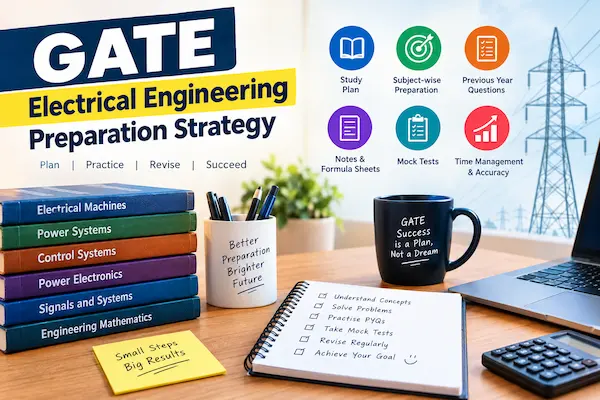
With proper planning, consistent practice, and the right study strategy, candidates can significantly improve their chances of achieving a good GATE score.
This guide explains an effective GATE Electrical Engineering preparation strategy, including subject-wise preparation, study planning, revision techniques, mock tests, and important tips for exam day.
What is GATE Electrical Engineering?
The Graduate Aptitude Test in Engineering (GATE) is a national-level examination that evaluates candidates on their understanding of engineering and science concepts.
For Electrical Engineering aspirants, the GATE EE syllabus covers core electrical engineering subjects along with Engineering Mathematics and General Aptitude. A strong understanding of these subjects is essential for achieving a competitive score.
GATE Electrical Engineering Syllabus
Before starting your preparation, understand the complete syllabus and divide it into manageable sections.
The major subjects include:
- Engineering Mathematics
- Electric Circuits
- Electromagnetic Fields
- Signals and Systems
- Electrical Machines
- Power Systems
- Control Systems
- Power Electronics
- Analog and Digital Electronics
- Electrical and Electronic Measurements
- General Aptitude
Understanding the syllabus helps you identify important topics and create a realistic preparation schedule.
1. Start with a Proper Study Plan
A well-structured study plan is the foundation of successful GATE preparation.
Instead of trying to study every subject at once, divide your preparation into phases:
Phase 1: Learn the Concepts
Start with the fundamental concepts of each subject. Focus on understanding formulas, principles, and their applications rather than simply memorizing them.
Phase 2: Practice Problems
After completing a topic, solve numerical problems and previous-year GATE questions. This helps you understand how concepts are tested in the actual examination.
Phase 3: Revision
Regular revision is essential because the GATE syllabus is extensive. Prepare short notes and formula sheets that can be reviewed quickly.
Phase 4: Mock Tests
Once you have completed a significant portion of the syllabus, start taking full-length and subject-wise mock tests. Analyse your mistakes after every test.
2. Give Priority to Core Electrical Engineering Subjects
Core subjects play a major role in GATE EE preparation. Pay special attention to subjects such as:
Electrical Machines
Focus on transformers, DC machines, induction machines, synchronous machines, and important numerical problems.
Power Systems
Important areas include power flow, fault analysis, transmission systems, protection, and electrical system fundamentals.
Control Systems
Understand transfer functions, block diagrams, stability, time response, frequency response, and control system analysis.
Power Electronics
Study semiconductor devices, converters, rectifiers, inverters, choppers, and their applications.
Signals and Systems
Focus on continuous and discrete-time signals, Fourier analysis, Laplace transforms, Z-transforms, and system properties.
Electric Circuits
Build a strong foundation in circuit laws, network theorems, transient analysis, AC circuits, and resonance.
3. Make Engineering Mathematics and General Aptitude Scoring Areas
Engineering Mathematics and General Aptitude can be highly useful for improving your overall GATE score.
For Mathematics, concentrate on topics such as:
- Linear Algebra
- Calculus
- Differential Equations
- Complex Variables
- Probability and Statistics
- Numerical Methods
For General Aptitude, regularly practise:
- Quantitative Aptitude
- Verbal Ability
- Logical Reasoning
- Data Interpretation
Consistent practice can help improve speed and accuracy in these sections.
4. Solve Previous-Year GATE Questions
Previous-year questions are one of the most valuable resources for GATE preparation.
Solving them helps you:
- Understand the question pattern
- Identify frequently tested concepts
- Improve problem-solving speed
- Understand the difficulty level
- Identify your weak areas
Try solving previous-year questions topic-wise initially. Later, practise them as complete subject-wise and full-length tests.
5. Prepare Short Notes and Formula Sheets
Preparing your own notes can make revision much easier.
For every subject, maintain a concise collection of:
- Important formulas
- Key concepts
- Short tricks
- Common mistakes
- Frequently asked concepts
- Difficult problems
During the final weeks of preparation, these notes can save significant time.
6. Take Regular Mock Tests
Mock tests are essential for evaluating your preparation.
Initially, you can take subject-wise tests. As the examination approaches, include full-length mock tests in your schedule.
After every mock test, analyse:
Attempted Questions → Correct Answers → Wrong Answers → Unattempted Questions → Time Management
Do not focus only on your score. The main purpose of a mock test is to identify mistakes and improve your performance.
7. Improve Time Management
GATE is not only a test of knowledge; it is also a test of speed and accuracy.
During preparation, practise solving questions within a specific time limit. Avoid spending too much time on a single difficult question.
A good approach is to:
- Solve questions you are confident about.
- Move to moderate-level questions.
- Attempt difficult questions if sufficient time remains.
- Review calculations and answers before submitting.
8. Focus on Accuracy
Avoid random guessing. Since GATE includes negative marking for certain types of questions, unnecessary attempts can reduce your score.
While practising, maintain an error log and record:
- Conceptual mistakes
- Calculation errors
- Formula mistakes
- Questions that took too much time
Review this error log regularly.
9. Follow a Consistent Daily Routine
Consistency is more important than studying for extremely long hours occasionally.
A daily study routine could include:
Concept Learning: 2–3 hours
Problem Solving: 2–3 hours
Revision: 1 hour
Previous-Year Questions: 1–2 hours
The exact schedule can be adjusted according to your preparation level and available time.
10. Revise Multiple Times
One-time preparation is not enough for a competitive examination like GATE.
A practical revision strategy is:
First Revision
Revise the subject after completing all major topics.
Second Revision
Focus on formulas, important concepts, and previous-year questions.
Final Revision
Use short notes and formula sheets for quick revision before the examination.
Common Mistakes to Avoid During GATE EE Preparation
Many candidates make avoidable mistakes during preparation. Some common ones are:
- Starting preparation without understanding the syllabus
- Using too many study materials
- Ignoring previous-year questions
- Avoiding weak subjects
- Not revising regularly
- Taking mock tests without analysing mistakes
- Focusing only on memorising formulas
- Poor time management
- Studying inconsistently
Avoiding these mistakes can make your preparation more effective.
GATE Electrical Engineering Preparation: Final Tips
A successful GATE preparation strategy should combine conceptual understanding, problem-solving practice, revision, and mock tests.
Keep the following points in mind:
- Understand the complete syllabus before starting.
- Build strong fundamentals in core EE subjects.
- Practise previous-year questions regularly.
- Maintain short notes and formula sheets.
- Take mock tests and analyse every mistake.
- Work continuously on speed and accuracy.
- Revise every subject multiple times.
- Stay consistent throughout your preparation.
Conclusion
Preparing for GATE Electrical Engineering requires discipline, consistency, and a structured approach. Instead of studying randomly, follow a clear plan that balances concept learning, numerical practice, previous-year questions, revision, and mock tests.
With strong fundamentals and regular practice, you can gradually improve your accuracy, speed, and confidence. Start early, track your progress, identify your weak areas, and keep improving throughout your preparation journey.
Remember: Smart preparation + Consistent practice + Regular revision = Better GATE performance.