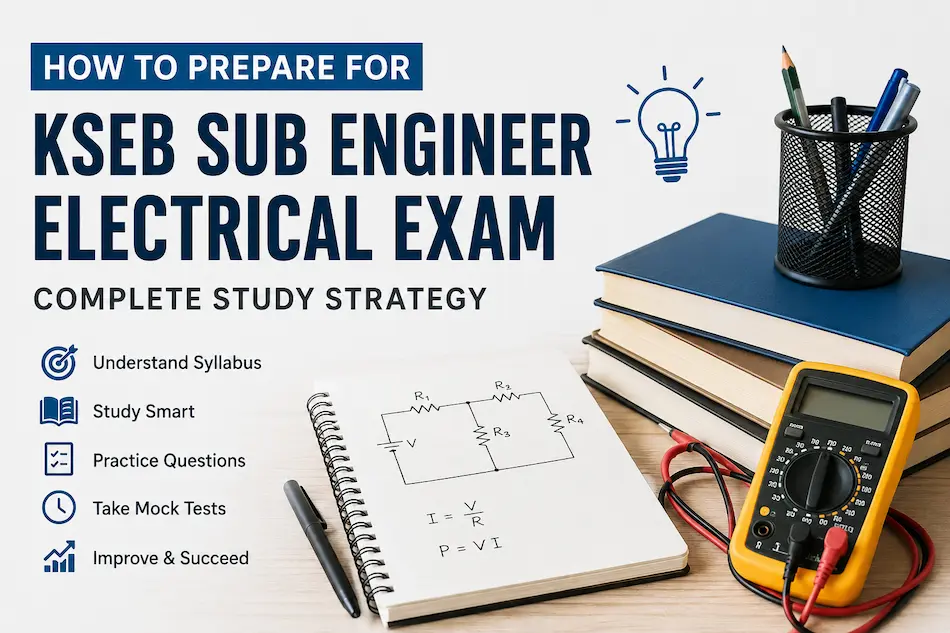
Whether you are starting your preparation or looking for a better way to revise, this guide will help you build an effective preparation strategy.
Why Proper Preparation Is Important
The KSEB Sub Engineer Electrical exam covers several areas of electrical engineering. Candidates need to understand concepts clearly and answer questions accurately within a limited time.
Many students spend a lot of time studying but do not get the expected results because they focus only on reading. Practice and revision are equally important.
A good preparation strategy should include:
- Understanding the syllabus
- Studying important electrical engineering topics
- Solving previous questions
- Regular revision
- Taking mock tests
- Improving speed and accuracy
1. Understand the Exam Syllabus
Before starting your preparation, understand the syllabus properly.
Make a list of the major topics and divide them into smaller sections. This will help you track your progress and avoid spending too much time on one subject.
Important areas may include:
- Electrical Circuits
- Electrical Machines
- Power Systems
- Measurements and Instrumentation
- Power Electronics
- Control Systems
- Basic Electronics
- Electrical Installation and Safety
- Generation, Transmission and Distribution
- Electrical Materials
Always refer to the latest official notification and syllabus before making your final study plan.
2. Build Strong Electrical Engineering Fundamentals
Competitive exams often test your understanding of basic concepts.
Instead of simply memorizing formulas, try to understand why and where a formula is used.
For example, when studying electrical circuits, make sure you understand:
- Ohm's Law
- Kirchhoff's Laws
- Series and parallel circuits
- Network theorems
- AC and DC circuits
- Power and energy calculations
A strong foundation makes it easier to solve application-based questions.
3. Give More Attention to Important Topics
You do not have to spend the same amount of time on every topic.
Identify frequently asked and high-value topics and give them more attention.
Create three categories:
High Priority: Topics you frequently see in previous questions.
Medium Priority: Topics that are important but have fewer questions.
Low Priority: Topics that are less frequently tested.
This approach helps you use your preparation time efficiently.
4. Practice Previous Questions
Previous questions are one of the best ways to understand the pattern of competitive examinations.
While solving previous questions, don't just check whether your answer is correct.
Ask yourself:
- Why is this answer correct?
- Which concept is being tested?
- Can the same concept be asked in another way?
- Did I take too much time to solve it?
Maintain a separate notebook for difficult questions and concepts that you repeatedly get wrong.
5. Make Mock Tests Part of Your Preparation
Mock tests are not only for checking your preparation after completing the syllabus.
They should be part of your regular study routine.
A mock test can help you understand:
- Your current preparation level
- Speed and accuracy
- Weak areas
- Frequently made mistakes
- Time management
- Exam pressure
After every mock test, spend some time analysing your mistakes.
Simply taking a test and checking the score is not enough. Test analysis is where much of the improvement happens.
6. Follow a Simple Daily Study Plan
A consistent study routine is more effective than studying for long hours occasionally.
For example, you can divide your daily preparation into four sessions:
Session 1 – Concept Study
Learn a new topic and understand the fundamentals.
Session 2 – Problem Solving
Solve numerical and conceptual questions related to the topic.
Session 3 – Revision
Revise formulas, important concepts and previously studied topics.
Session 4 – Practice Test
Solve a short set of questions or take a mock test.
You can adjust the duration of each session according to your available time.
7. Maintain a Formula and Mistake Notebook
Electrical engineering involves many formulas, relationships and technical concepts.
Maintain a small notebook containing:
- Important formulas
- Short tricks
- Frequently asked concepts
- Difficult questions
- Your common mistakes
Revise this notebook regularly, especially during the final stage of preparation.
8. Improve Speed and Accuracy
Knowing the answer is not enough in a competitive examination. You also need to reach the answer quickly and accurately.
During mock tests, monitor:
Time Taken + Correct Answers + Wrong Answers
If you are taking too much time on a particular topic, practice more questions from that area.
At the same time, avoid guessing answers without proper understanding, especially when negative marking is applicable.
9. Avoid These Common Preparation Mistakes
Many candidates make the same mistakes during competitive exam preparation.
Studying Without a Plan
Jumping randomly between different topics can make preparation confusing.
Only Reading Theory
Reading textbooks without solving questions does not provide enough exam practice.
Ignoring Weak Topics
Students often study only their favourite subjects. Spend additional time on topics where your performance is weak.
Taking Mock Tests Without Analysis
A mock test score tells you your current performance. The mistakes tell you how to improve it.
Leaving Revision Until the End
Regular revision helps you retain concepts for a longer period.
10. Use Mock Tests to Track Your Progress
Your mock test scores can be used as a simple progress indicator.
For example:
Week 1: 48%
Week 2: 56%
Week 3: 64%
Week 4: 72%
The goal should not be to get a perfect score immediately.
Instead, focus on continuous improvement in accuracy, speed and conceptual understanding.
How Electric Sine Can Help
Preparing for a competitive electrical examination becomes easier when you have access to regular practice.
Electric Sine provides practice and mock-test resources designed for students preparing for electrical engineering competitive examinations.
Instead of waiting until the final days before the exam, use mock tests regularly throughout your preparation.
You can use your test results to identify weak topics, revise them, and test yourself again.
Final Preparation Strategy
A simple formula for effective preparation is:
Learn → Practice → Test → Analyse → Revise → Repeat
Do not depend on last-minute preparation.
Start with the fundamentals, gradually increase your question-solving practice, take regular mock tests, and analyse every mistake.
With consistent preparation and the right strategy, you can improve both your confidence and performance in the KSEB Sub Engineer Electrical Exam.
Frequently Asked Questions
1. How should I start preparing for the KSEB Sub Engineer Electrical Exam?
Start by understanding the latest syllabus and exam pattern. Then divide the syllabus into topics and create a realistic daily study schedule.
2. Are mock tests important for KSEB Sub Engineer preparation?
Yes. Mock tests help improve speed, accuracy, time management and exam confidence. They also help identify weak areas.
3. Should I solve previous questions?
Yes. Previous questions can help you understand the type and difficulty of questions commonly asked in competitive examinations.
4. How often should I take mock tests?
You can start with one or two tests per week and gradually increase the frequency as the exam approaches.
5. Is revision important for electrical engineering exams?
Absolutely. Regular revision helps retain formulas, concepts and important technical information.
Start Your Preparation Today
Don't wait until the exam date is near to start testing your preparation.
Study consistently. Practice regularly. Take mock tests. Analyse your mistakes. Improve every day.
Prepare smarter with Electric Sine and take one step closer to your exam goal.