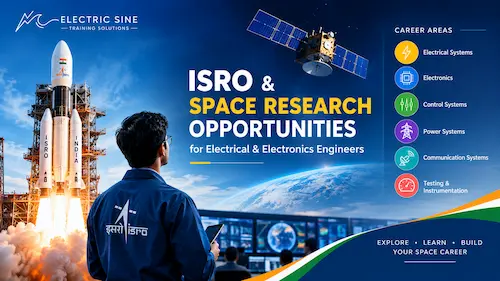
A career in the space sector is an exciting option for engineering students who are interested in technology, research, innovation and complex engineering systems. In India, the Indian Space Research Organisation (ISRO) and the wider Department of Space provide career opportunities across several scientific and technical disciplines.
For Electrical and Electronics Engineering students, the space sector can connect engineering fundamentals with applications involving electrical systems, electronics, power systems, control systems, communication, testing and instrumentation.
ISRO's official career information lists opportunities in disciplines including Electrical, Electronics, Mechanical, Computer Science, Physics, Chemistry and Mathematics, depending on the recruitment and organisational requirements.
This makes space research and space technology an important career area for students who want to apply their engineering knowledge to challenging technical projects.
Why Consider a Career in Space Research?
Space missions require the integration of many engineering disciplines. A spacecraft, launch vehicle, satellite or ground-support system depends on numerous electrical and electronic subsystems working together.
Electrical and Electronics Engineers can develop knowledge that is relevant to areas such as:
- Electrical systems
- Power systems
- Electronics
- Control systems
- Communication systems
- Instrumentation
- Testing and measurement
- Signal processing
- Embedded systems
- Automation and monitoring
Working in such technology-driven environments can also expose engineers to areas where reliability, precision, testing and system-level engineering are extremely important.
1. Electrical Systems in Space Technology
Electrical engineering plays an important role in providing and managing electrical power for space-related systems.
Engineers need a strong understanding of concepts such as:
- Electrical circuits
- Electrical machines
- Power electronics
- Power distribution
- DC and AC systems
- Voltage regulation
- Protection systems
- Electrical measurements
- Power conversion
For EEE students, a strong foundation in basic electrical engineering can therefore be useful when exploring space-sector engineering careers.
Important subjects to study
Students should pay attention to:
Electrical Circuits → Electrical Machines → Power Electronics → Power Systems → Control Systems → Measurements & Instrumentation
A strong understanding of these subjects can also help students prepare for technical recruitment examinations.
2. Power Systems and Power Electronics
Power is a critical part of any complex engineering system.
In space technology, engineers work with systems where electrical power needs to be generated, converted, controlled, distributed and monitored efficiently.
Students interested in this area can develop knowledge in:
- Power electronics
- Converters
- Inverters
- DC-DC converters
- Voltage regulation
- Battery systems
- Electrical power management
- Switching devices
- Power semiconductor devices
Understanding power electronics can be particularly useful because modern engineering systems increasingly depend on efficient and reliable power conversion.
3. Electronics Engineering Opportunities
Electronics is another major engineering discipline associated with space technology.
Electronic systems can be involved in areas such as:
- Signal processing
- Data acquisition
- Sensors
- Embedded systems
- Digital electronics
- Analog electronics
- Communication electronics
- Control electronics
- Instrumentation
Students from Electronics and Communication Engineering (ECE) and related disciplines can therefore explore space-sector opportunities in addition to traditional electronics industries.
ISRO's recruitment history includes Scientist/Engineer positions in Electronics, and its current recruitment information continues to show engineering recruitment based on specific disciplines and notifications.
4. Control Systems and Automation
Control engineering is an important area for students interested in aerospace and space technology.
Control systems are used to monitor and regulate engineering processes and help systems respond appropriately to changing conditions.
Students interested in this field should understand:
- Transfer functions
- Block diagrams
- Feedback systems
- Stability
- Time response
- Frequency response
- Controllers
- Sensors
- Actuators
- Digital control
A strong foundation in Control Systems can be valuable for engineers interested in automation, aerospace systems and other advanced engineering applications.
5. Communication Systems
Space missions depend heavily on communication and data transmission.
Communication-related engineering involves technologies that enable information to be transmitted between spacecraft, satellites, ground stations and other systems.
Students interested in this area can study:
- Analog communication
- Digital communication
- Signals and systems
- Antennas
- Electromagnetic theory
- Microwave engineering
- Satellite communication
- Signal processing
- Communication networks
These subjects can provide a foundation for careers related to satellite and space communication technologies.
6. Testing and Instrumentation
Testing is an essential part of engineering development.
Space-related systems need extensive testing because the equipment must meet demanding performance and reliability requirements.
Instrumentation engineers can develop skills in:
- Sensors
- Transducers
- Measurement systems
- Data acquisition
- Calibration
- Instrumentation systems
- Electronic testing
- Signal conditioning
- Industrial measurements
For Electrical and Electronics Engineering students, Measurements and Instrumentation can therefore be an important subject to master.
7. Electrical and Electronics Engineers Should Build Strong Fundamentals
Students often focus heavily on recruitment examinations while overlooking their engineering fundamentals.
For technical careers, it is important to build a strong understanding of core subjects.
Electrical Engineering students should focus on:
- Electrical Circuits
- Electrical Machines
- Power Systems
- Power Electronics
- Control Systems
- Electrical Measurements
- Signals and Systems
- Digital Electronics
- Analog Electronics
- Engineering Mathematics
Depending on the specific discipline and recruitment notification, the required subjects can vary.
8. ISRO Scientist/Engineer Career Opportunities
One of the important technical career routes within ISRO is the Scientist/Engineer category.
ISRO's official career information states that Scientist/Engineer opportunities are available for graduates, postgraduates and doctorates in various disciplines, including Electrical and Electronics, depending on the requirements of the organisation. Recruitment is conducted through the appropriate recruitment process, including the ISRO Centralised Recruitment Board (ICRB) for applicable posts.
Recruitment notifications specify important details such as:
- Educational qualification
- Required engineering discipline
- Age requirements
- Selection procedure
- Examination details
- Application dates
- Number of vacancies
- Other eligibility conditions
Therefore, students should always check the official ISRO recruitment notification before applying rather than relying only on information from third-party websites.
9. Other Technical Career Routes
Space-sector careers are not limited to one type of position.
ISRO's official career information also lists technical opportunities such as:
- Scientist/Engineer
- Technical Assistant
- Scientific Assistant
- Technician
- Draughtsman
- Research positions
- Apprenticeship opportunities
Eligibility varies according to the position. For example, ISRO's career information describes Technical Assistant opportunities for candidates with relevant engineering diplomas, while Technician positions have different qualification requirements.
Research-oriented opportunities can also include positions such as Junior Research Fellow, Research Associate and Project Scientist, depending on current requirements.
10. What Should EEE Students Study for ISRO-Related Careers?
If you are an Electrical and Electronics Engineering student interested in space-sector opportunities, start with the fundamentals.
Core Electrical Subjects
- Electrical Circuit Theory
- Electrical Machines
- Power Systems
- Power Electronics
- Control Systems
- Electrical Measurements
- Signals and Systems
Electronics and Technology Subjects
- Analog Electronics
- Digital Electronics
- Communication Systems
- Microprocessors and Microcontrollers
- Embedded Systems
- Instrumentation
- Electromagnetic Theory
Supporting Skills
In addition to academic subjects, students can develop:
- Problem-solving ability
- Numerical aptitude
- Technical analysis
- Programming fundamentals
- Simulation skills
- Data interpretation
- Technical communication
The exact preparation should always be aligned with the latest official recruitment notification and the candidate's discipline.
11. Practical Learning Can Make a Difference
Engineering students should not depend entirely on theoretical learning.
Practical projects can help students understand how engineering concepts work in real applications.
For example, an EEE student can work on projects involving:
- Solar power systems
- Battery management
- DC-DC converters
- Motor control
- Sensor-based systems
- Microcontroller projects
- Power monitoring
- Automatic control systems
- Data acquisition
- Embedded systems
These projects can help connect classroom concepts with practical engineering applications.
12. Prepare Through Previous Questions and Mock Tests
Technical recruitment preparation requires both conceptual understanding and problem-solving practice.
Students can improve their preparation by:
- Revising engineering fundamentals
- Creating subject-wise notes
- Solving previous questions
- Practising numerical problems
- Taking timed mock tests
- Identifying weak subjects
- Revising regularly
- Tracking preparation progress
For Electric Sine, this section can naturally link to your Electrical Engineering MCQs, mock tests and previous-year-question resources.
Example internal link placement
Students preparing for technical engineering examinations can strengthen their concepts by practising Electrical Engineering MCQs and Mock Tests regularly.
You can link Electrical Engineering MCQs, Mock Tests, and Previous Year Questions to the relevant pages on Electric Sine.
13. ISRO Careers Are Not Limited to One Engineering Branch
Space technology is multidisciplinary.
Different projects can require expertise from areas such as:
| Engineering / Science Area | Related Knowledge |
|---|---|
| Electrical Engineering | Power systems, electrical systems, machines |
| Electronics Engineering | Digital electronics, analog electronics, embedded systems |
| Communication | Signals, antennas, communication systems |
| Control Engineering | Feedback, controllers, automation |
| Instrumentation | Sensors, measurements, data acquisition |
| Mechanical Engineering | Mechanical systems and structures |
| Computer Science | Software, computing and data systems |
| Physics | Space science and scientific research |
The availability of specific posts and disciplines changes according to organisational requirements and individual recruitment notifications. ISRO explicitly notes that opportunities may open for other disciplines as required in the future.
14. How to Start Preparing for a Space Research Career
If you are currently pursuing B.Tech or another engineering qualification, you do not have to wait until graduation to begin preparing.
Step 1: Strengthen your fundamentals
Start with core subjects such as Electrical Circuits, Machines, Power Systems, Power Electronics and Control Systems.
Step 2: Practise numerical problems
Technical subjects require the ability to apply formulas and concepts to problems.
Step 3: Solve previous questions
Previous questions can help you understand the style and difficulty of technical examinations.
Step 4: Take mock tests
Timed practice helps improve speed, accuracy and exam management.
Step 5: Develop practical skills
Work on small electrical, electronics, control or instrumentation projects.
Step 6: Follow official notifications
Recruitment conditions, disciplines, dates and selection procedures can change. Always verify the latest information through the official ISRO careers portal.
15. Current ISRO Opportunities: Check Official Notifications
ISRO regularly publishes recruitment notifications through its official career portal.
As of September 2026, the official careers pages list multiple types of opportunities across ISRO centres and related organisations, including Scientist/Engineer recruitment, research positions, apprenticeships and technical posts.
For example, ISRO's current opportunities page lists recruitment under the Centralised Recruitment Board, while individual centres such as SAC, URSC, LPSC and HSFC publish their own opportunities when required.
Important: Current vacancies, eligibility, application deadlines and selection procedures can change. Candidates should use the official ISRO website as the final source of recruitment information.
16. Skills That Can Help Electrical Engineers
For students interested in space technology, developing a combination of theoretical knowledge, practical skills and problem-solving ability can be useful.
Technical Skills
- Circuit analysis
- Power systems
- Power electronics
- Control systems
- Electronics
- Instrumentation
- Communication
- Embedded systems
- Electrical measurements
- Programming fundamentals
Professional Skills
- Problem solving
- Analytical thinking
- Technical documentation
- Teamwork
- Communication
- Project management
- Continuous learning
The goal should not simply be to memorize topics for an examination. Students should aim to understand how electrical and electronic systems work and how different engineering concepts interact in a complete system.
17. Why Electrical Engineering Fundamentals Matter
Space technology may involve highly advanced systems, but those systems are built on fundamental engineering principles.
For example:
Electrical Circuits → Power Electronics → Electrical Power Systems → Control → Instrumentation → Integrated Systems
Understanding basic concepts makes it easier to learn advanced technologies later.
This is why students should not ignore subjects such as circuit theory, network analysis, control systems and measurements.
For students preparing for technical careers, strong fundamentals can provide a foundation for both competitive examinations and future engineering work.
18. Build Your Career Step by Step
A possible preparation path for an engineering student can look like this:
B.Tech / Engineering Fundamentals
↓
Core Electrical & Electronics Subjects
↓
Problem-Solving Practice
↓
Previous Questions & Mock Tests
↓
Practical Projects
↓
Technical Skill Development
↓
Monitor Official Recruitment Notifications
↓
Apply When Eligible
This approach can also help students keep multiple career options open across electrical, electronics, automation, instrumentation, power and other engineering sectors.
Frequently Asked Questions
Is ISRO a career option for Electrical Engineers?
Yes. ISRO's official career information includes Electrical among the disciplines for which Scientist/Engineer opportunities have been offered, subject to the requirements of individual recruitment notifications.
Can EEE students apply for ISRO jobs?
Eligibility depends on the specific recruitment notification. Candidates should check the required discipline, qualification and other conditions in the official notification before applying.
What subjects should EEE students study for ISRO-related opportunities?
Important areas can include Electrical Circuits, Electrical Machines, Power Systems, Power Electronics, Control Systems, Measurements and other subjects specified by the relevant recruitment notification.
Are there opportunities other than Scientist/Engineer posts?
Yes. ISRO's career information lists technical and scientific categories including Technical Assistant, Scientific Assistant, Technician and research-related opportunities, depending on requirements.
Where can I find official ISRO recruitment notifications?
ISRO publishes recruitment information through its official Careers and Current Opportunities pages.
Conclusion
A career in space research can be an exciting pathway for Electrical and Electronics Engineering students who are interested in advanced technology, engineering systems and scientific applications.
Electrical systems, power electronics, control systems, electronics, communication, instrumentation and testing are all important areas of knowledge for engineers working with complex technological systems.
For students interested in ISRO-related careers, the best preparation begins with strong engineering fundamentals, regular problem-solving practice, practical projects and continuous awareness of official recruitment notifications.
Whether your goal is a career in ISRO, another government engineering organisation, the private aerospace industry or advanced technology sectors, building strong Electrical and Electronics Engineering skills can provide a valuable foundation.
Learn. Practise. Build your engineering skills. Prepare for your future.