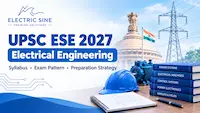
For Electrical Engineering graduates, UPSC ESE Electrical Engineering provides an opportunity to enter various Central Government engineering services through a highly competitive selection process.
This article covers the UPSC ESE Electrical Engineering eligibility, exam pattern, syllabus, important subjects, preparation strategy and career opportunities.
What is UPSC ESE / IES?
The Engineering Services Examination (ESE) is conducted by the Union Public Service Commission (UPSC) for recruitment to engineering positions in various departments and organizations of the Government of India.
The examination is conducted for four major engineering disciplines:
- Civil Engineering
- Mechanical Engineering
- Electrical Engineering
- Electronics & Telecommunication Engineering
Candidates who qualify for the Electrical Engineering category can be considered for engineering services and posts associated with the Electrical Engineering discipline, subject to the vacancies and applicable recruitment rules.
UPSC ESE Electrical Engineering – Why is it Important?
UPSC ESE is particularly relevant for engineering graduates interested in technical government services.
Some important features include:
- Central Government engineering career opportunities
- Technical and engineering-oriented job roles
- Competitive salary and allowances according to the applicable government rules
- Opportunities for career progression
- Responsible technical and administrative roles
- Work related to major infrastructure and engineering projects
Because of the limited number of vacancies and high competition, candidates generally need strong fundamentals and consistent preparation.
UPSC ESE Electrical Engineering Eligibility
Candidates applying for the Electrical Engineering category generally need to satisfy the educational qualification, age and other eligibility requirements specified in the official UPSC notification for the respective examination year.
Educational Qualification
Candidates should have the required engineering qualification in Electrical Engineering or an applicable equivalent qualification as specified by UPSC.
The exact accepted qualifications should always be checked against the official UPSC ESE notification for the relevant year.
Age Limit
UPSC specifies the age requirements in the official ESE notification. Age relaxations may be applicable to certain categories according to Government of India rules.
Since eligibility conditions can change between examination years, candidates should verify the latest official notification before applying.
UPSC ESE Exam Pattern
The Engineering Services Examination consists of multiple stages.
Stage 1 – Preliminary Examination
The Preliminary Examination consists of two objective-type papers:
Paper 1 – General Studies and Engineering Aptitude
This paper covers areas such as:
- Current affairs
- Engineering aptitude
- Logical reasoning
- Engineering mathematics
- Numerical analysis
- General principles of design
- Environmental engineering
- Project management
- Materials science
- ICT-related topics
- Ethics and values related to engineering
Paper 2 – Electrical Engineering
This paper focuses on the technical subjects of Electrical Engineering.
Stage 2 – Main Examination
Candidates who qualify for the Preliminary Examination appear for the Electrical Engineering conventional/descriptive papers in the Main Examination.
The Main Examination tests the candidate's ability to understand concepts, solve engineering problems and present technical answers clearly.
Stage 3 – Personality Test
Candidates who qualify through the written stages are called for the Personality Test.
The final selection is based on the marks obtained in the applicable stages as specified by UPSC.
Candidates should always refer to the latest UPSC ESE notification for the exact marks, qualifying criteria, negative marking provisions and selection rules applicable to their examination year.
UPSC ESE Electrical Engineering Syllabus
The technical syllabus covers major subjects from the Electrical Engineering curriculum.
1. Electrical Circuits and Fields
Important areas include:
- Circuit laws
- Network theorems
- AC and DC circuits
- Transient analysis
- Resonance
- Two-port networks
- Magnetic circuits
- Electrostatics
- Electromagnetic fields
2. Electrical Materials
This area includes:
- Conducting materials
- Magnetic materials
- Dielectric materials
- Insulating materials
- Semiconductor materials
- Electrical properties of materials
3. Measurements and Instrumentation
Important topics include:
- Measurement techniques
- Electrical measuring instruments
- Bridges
- Digital instruments
- Errors and uncertainty
- Transducers
- Instrumentation systems
4. Computer Fundamentals
Candidates may need to study:
- Computer fundamentals
- Programming concepts
- Data representation
- Basic computer architecture
- Information technology fundamentals
5. Electronics and Communication
Important topics can include:
- Semiconductor devices
- Diodes
- Transistors
- Amplifiers
- Oscillators
- Digital electronics
- Communication fundamentals
6. Electrical Machines
Electrical Machines is an important part of Electrical Engineering preparation.
Topics include:
- Transformers
- DC machines
- Induction motors
- Synchronous machines
- Special machines
- Machine characteristics
- Starting and speed control
7. Power Systems
Important topics include:
- Generation of electrical power
- Transmission
- Distribution
- Power system analysis
- Fault analysis
- Protection
- Circuit breakers
- Relays
- Power system stability
8. Power Electronics and Drives
Important areas include:
- Power semiconductor devices
- Rectifiers
- Inverters
- Choppers
- AC controllers
- DC drives
- AC drives
- Power electronic applications
9. Analog and Digital Electronics
Candidates should understand:
- Analog circuits
- Operational amplifiers
- Digital logic
- Combinational circuits
- Sequential circuits
- Counters
- Registers
- Digital systems
10. Control Systems
Important topics include:
- Open-loop and closed-loop systems
- Transfer functions
- Block diagrams
- Signal flow graphs
- Time-domain analysis
- Frequency response
- Stability
- Controllers
- State-space analysis
Important Subjects for UPSC ESE Electrical Engineering
A strong preparation plan should cover the complete syllabus rather than focusing only on a few subjects.
Some of the major technical subjects are:
| Subject | Key Areas |
|---|---|
| Electrical Circuits | Network analysis, AC/DC circuits |
| Electrical Machines | Transformers, motors, generators |
| Power Systems | Generation, transmission, protection |
| Control Systems | Stability, response, controllers |
| Power Electronics | Converters, inverters, drives |
| Measurements | Instruments, bridges, transducers |
| Analog Electronics | Diodes, transistors, amplifiers |
| Digital Electronics | Logic circuits, counters, registers |
| Electrical Materials | Conductors, insulators, magnetic materials |
| Engineering Mathematics | Mathematical and analytical concepts |
How to Prepare for UPSC ESE Electrical Engineering
1. Understand the Complete Syllabus
Start by downloading and studying the latest official syllabus. Divide the syllabus into individual subjects and topics.
2. Build Strong Fundamentals
ESE preparation requires a strong understanding of core Electrical Engineering concepts.
Instead of memorizing formulas alone, understand:
- Why the formula works
- Where it can be applied
- How the parameters affect the result
- How different concepts are connected
3. Prepare Subject-Wise
Study one subject systematically before moving to the next. Maintain short notes containing:
- Important formulas
- Key concepts
- Important definitions
- Frequently used methods
- Common mistakes
4. Practice Previous Year Questions
Previous year questions can help you understand the nature and difficulty of the examination.
After completing a topic, solve relevant previous year questions and analyze your mistakes.
5. Take Mock Tests
Regular mock tests can help improve:
- Time management
- Accuracy
- Question selection
- Speed
- Exam confidence
6. Revise Regularly
Revision is essential because the ESE syllabus covers many technical subjects.
A practical revision cycle can include:
First Revision → Practice → Second Revision → Mock Tests → Final Revision
UPSC ESE Preparation Strategy for Beginners
If you are starting your preparation from the beginning, you can follow a structured approach.
Phase 1 – Concept Building
Start with core subjects and understand the fundamentals.
Phase 2 – Problem Solving
Solve numerical problems and previous year questions after completing each topic.
Phase 3 – Revision
Prepare concise revision notes and regularly revise completed subjects.
Phase 4 – Mock Tests
Start full-length and subject-wise mock tests after completing a significant portion of the syllabus.
Phase 5 – Final Revision
Focus on formulas, important concepts, previous mistakes and frequently tested areas.
Common Mistakes to Avoid
ESE aspirants should avoid:
- Studying without understanding the syllabus
- Using too many study materials
- Ignoring previous year questions
- Avoiding revision
- Spending too much time on one topic
- Not analyzing mock-test performance
- Preparing only theoretical concepts without problem solving
UPSC ESE Electrical Engineering Career Opportunities
Successful candidates can be appointed to engineering services/posts under various Central Government departments, depending on the vacancies and applicable service rules for the examination year.
Electrical Engineering professionals may work in areas related to:
- Power and energy systems
- Railways
- Defence-related engineering services
- Public infrastructure
- Government engineering projects
- Technical administration
- Electrical system planning and management
The actual services and posts available can vary from one recruitment cycle to another.
UPSC ESE vs GATE for Electrical Engineers
UPSC ESE and GATE are both important examinations for Electrical Engineering graduates, but they serve different purposes.
| Feature | UPSC ESE | GATE |
|---|---|---|
| Conducting Body | UPSC | IISc/IITs on a rotational basis |
| Main Purpose | Engineering Services recruitment | Higher studies, PSU opportunities and other uses |
| Question Types | Objective + Conventional stages | Primarily computer-based test |
| Interview/Personality Stage | Yes, as part of ESE selection | Depends on the opportunity |
| Focus | Government engineering services | Higher education and technical opportunities |
Candidates should choose their preparation strategy based on their career goals and the eligibility requirements of the opportunities they are targeting.
How Electric Sine Can Help ESE Aspirants
Electric Sine is an online learning platform focused on Electrical Engineering, Electronics Engineering and Instrumentation.
For students preparing for competitive examinations, a structured learning platform can help with:
- Electrical Engineering concepts
- Practice questions
- MCQs
- Previous year questions
- Mock tests
- Topic-wise preparation
- Exam-oriented revision
A combination of conceptual learning, question practice and regular revision can make preparation more systematic.
Frequently Asked Questions – UPSC ESE Electrical Engineering
Is ESE suitable for Electrical Engineering graduates?
Yes. UPSC ESE includes Electrical Engineering as one of its engineering disciplines.
What is the full form of ESE?
ESE stands for Engineering Services Examination.
Is ESE also called IES?
Yes. Engineering Services Examination is commonly referred to as IES (Indian Engineering Services).
Is GATE required for UPSC ESE?
UPSC ESE has its own examination and selection process. Candidates should check the latest UPSC notification for the eligibility and selection requirements.
What are the major subjects for ESE Electrical Engineering?
Major subjects include Electrical Circuits, Electrical Machines, Power Systems, Control Systems, Power Electronics, Measurements and Instrumentation, Analog and Digital Electronics, Electrical Materials and related engineering topics.
How can I prepare for ESE Electrical Engineering?
Start with the official syllabus, build strong fundamentals, solve previous year questions, practice mock tests and revise regularly.
Final Thoughts
UPSC ESE Electrical Engineering is an important examination for engineering graduates interested in Central Government engineering services. Successful preparation requires a combination of strong technical fundamentals, problem-solving practice, revision and mock-test analysis.
Before applying, candidates should always check the latest official UPSC notification for eligibility, syllabus, vacancies, examination dates and selection rules.
For Electrical Engineering students preparing for competitive examinations, building strong fundamentals and practicing questions consistently can provide a structured foundation for exam preparation.
Explore Electrical Engineering learning resources, MCQs and practice materials on Electric Sine.