
Let's understand one important MCQ in detail.
MCQ
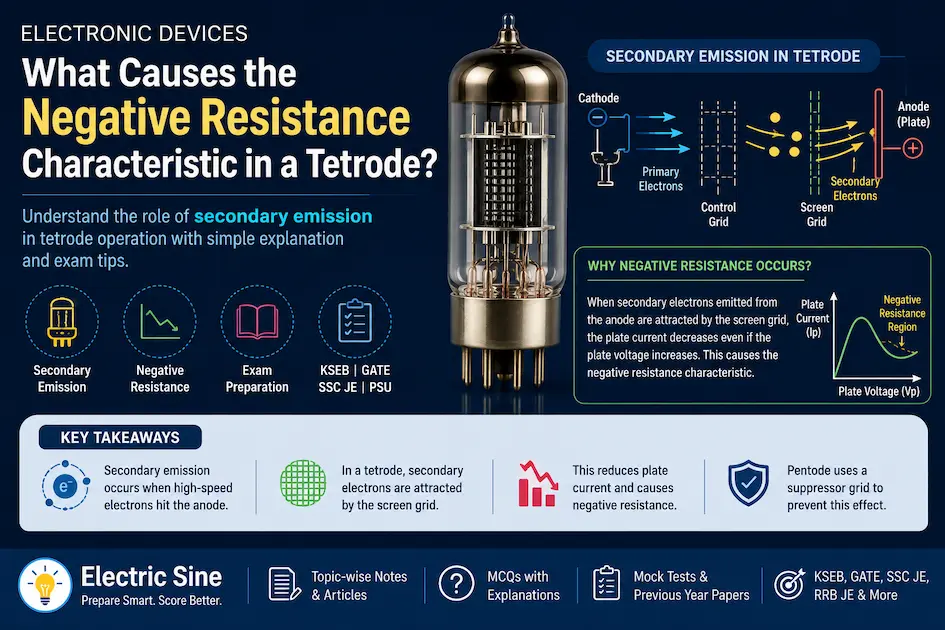
What causes the negative resistance characteristic in a tetrode?
A. Grid biasing
B. Anode voltage
C. Secondary emissions ✅
D. Cathode temperature
Correct Answer: C. Secondary emissions
What is a Tetrode?
A tetrode is a vacuum tube that consists of four electrodes:
- Cathode
- Control Grid
- Screen Grid
- Plate (Anode)
The screen grid is placed between the control grid and the anode to reduce the unwanted capacitance between them and improve amplification at higher frequencies.
Why Does a Tetrode Show Negative Resistance?
The negative resistance characteristic occurs because of a phenomenon known as secondary emission.
When electrons emitted from the cathode travel at high speed and strike the anode, they can dislodge additional electrons from the anode surface. These newly released electrons are called secondary electrons.
Under certain operating conditions, the screen grid has a higher positive potential than the anode. As a result, many of these secondary electrons are attracted toward the screen grid instead of returning to the anode.
This reduces the plate current even though the plate voltage is increasing.
Normally,
- Increase in plate voltage → Increase in plate current
But in a tetrode affected by secondary emission,
- Increase in plate voltage → Decrease in plate current
This unusual behavior is known as the negative resistance characteristic.
Why is Secondary Emission a Problem?
Secondary emission creates several undesirable effects:
- Reduction in plate current
- Distortion in amplifier performance
- Unstable operation
- Reduced efficiency
- Negative resistance region in the characteristic curve
Because of these issues, engineers developed the pentode, which includes an additional suppressor grid to prevent secondary electrons from reaching the screen grid.
How Does a Pentode Solve This Problem?
A pentode contains five electrodes instead of four.
The extra electrode, called the suppressor grid, repels secondary electrons back toward the plate. This eliminates the negative resistance region and improves amplifier performance.
This is one of the most important differences between a tetrode and a pentode.
Quick Exam Notes
✔ A tetrode has four electrodes.
✔ The negative resistance characteristic is caused by secondary emission.
✔ Secondary electrons are attracted to the screen grid.
✔ A pentode uses a suppressor grid to eliminate secondary emission effects.
Memory Trick
Remember:
Tetrode → Secondary Emission → Negative Resistance
or simply
T → S → N
This shortcut is useful for last-minute revision before competitive exams.
Practice MCQs
1. What causes the negative resistance characteristic in a tetrode?
A. Grid biasing
B. Anode voltage
✅ C. Secondary emissions
D. Cathode temperature
2. Which electrode attracts secondary electrons in a tetrode?
A. Cathode
A. Control Grid
✅ C. Screen Grid
D. Suppressor Grid
3. Which vacuum tube eliminates the effect of secondary emission?
A. Diode
B. Triode
C. Tetrode
✅ D. Pentode
4. How many electrodes are present in a tetrode?
A. Two
B. Three
✅ C. Four
D. Five
Frequently Asked Question (FAQ)
What is secondary emission?
Secondary emission is the release of electrons from the anode surface when high-speed electrons strike it.
Why does a tetrode exhibit negative resistance?
Because secondary electrons are attracted to the screen grid instead of returning to the plate, causing the plate current to decrease as plate voltage increases.
Which device eliminates secondary emission?
A pentode uses a suppressor grid to prevent secondary electrons from reaching the screen grid.
Conclusion
The negative resistance characteristic in a tetrode is caused by secondary emission. This occurs when electrons emitted from the anode are attracted to the positively charged screen grid, resulting in a reduction in plate current even as plate voltage increases. Understanding this concept is important for students preparing for KSEB, GATE Electrical, SSC JE, RRB JE, PSU, and other electrical engineering competitive examinations.
At Electric Sine, we simplify complex electrical engineering concepts into easy-to-understand explanations with exam-oriented MCQs, helping aspirants improve both conceptual understanding and exam performance.